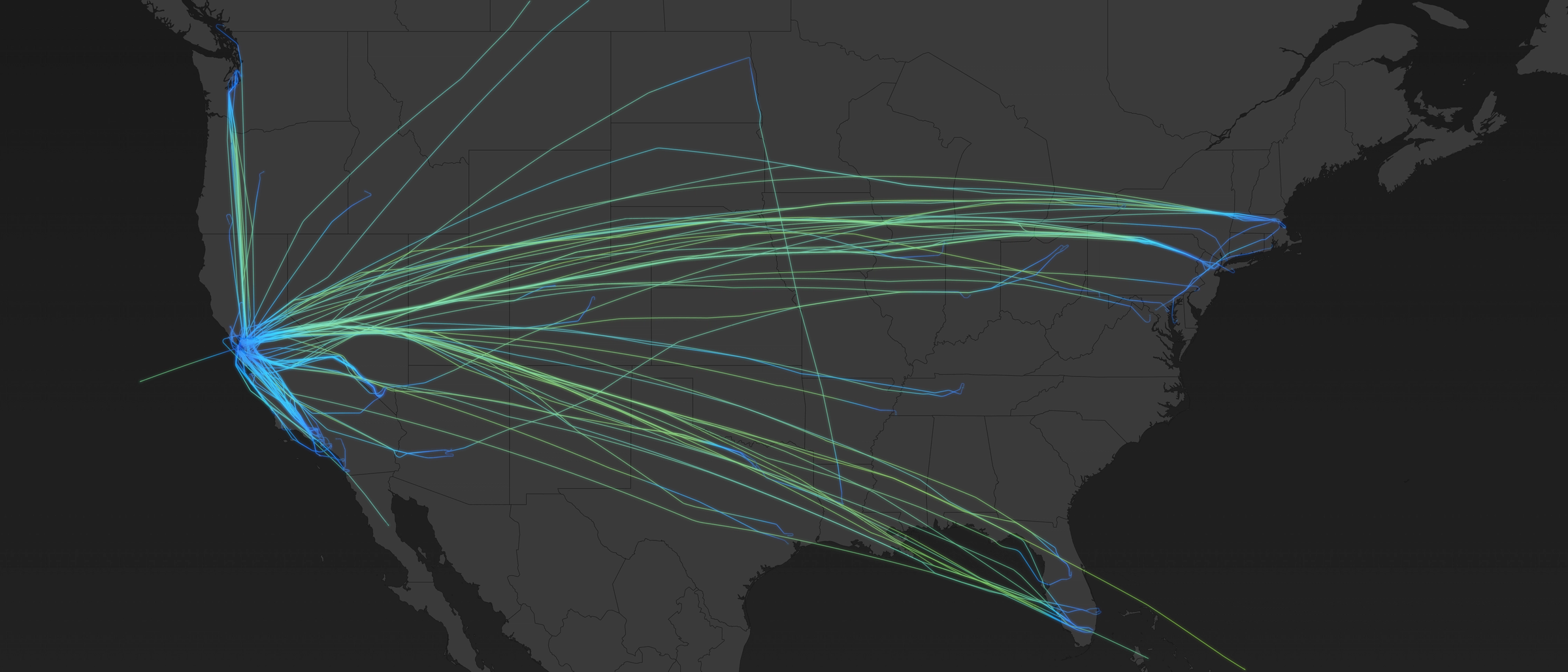
The morning after Super Bowl LX in the San Francisco Bay Area, we tracked a significant surge in private jet activity as attendees departed the region. Between 7:00 PM local time on Sunday, February 8 (03:00 UTC February 9) and 2:00 AM Monday morning (10:00 UTC), we observed 132 unique US-registered private aircraft departing from Bay Area airports—a dramatic increase from typical Sunday night traffic.
Timing and Volume
The departure exodus began at 7:01 PM local (03:01 UTC) with a Gulfstream G450 leaving San Jose bound for the East Coast. Peak activity occurred between 8:00-9:00 PM local (04:00-05:00 UTC) with 46 departures in that hour alone. The wave continued through early morning, with the final tracked departure at 12:53 AM (08:53 UTC).
The Numbers
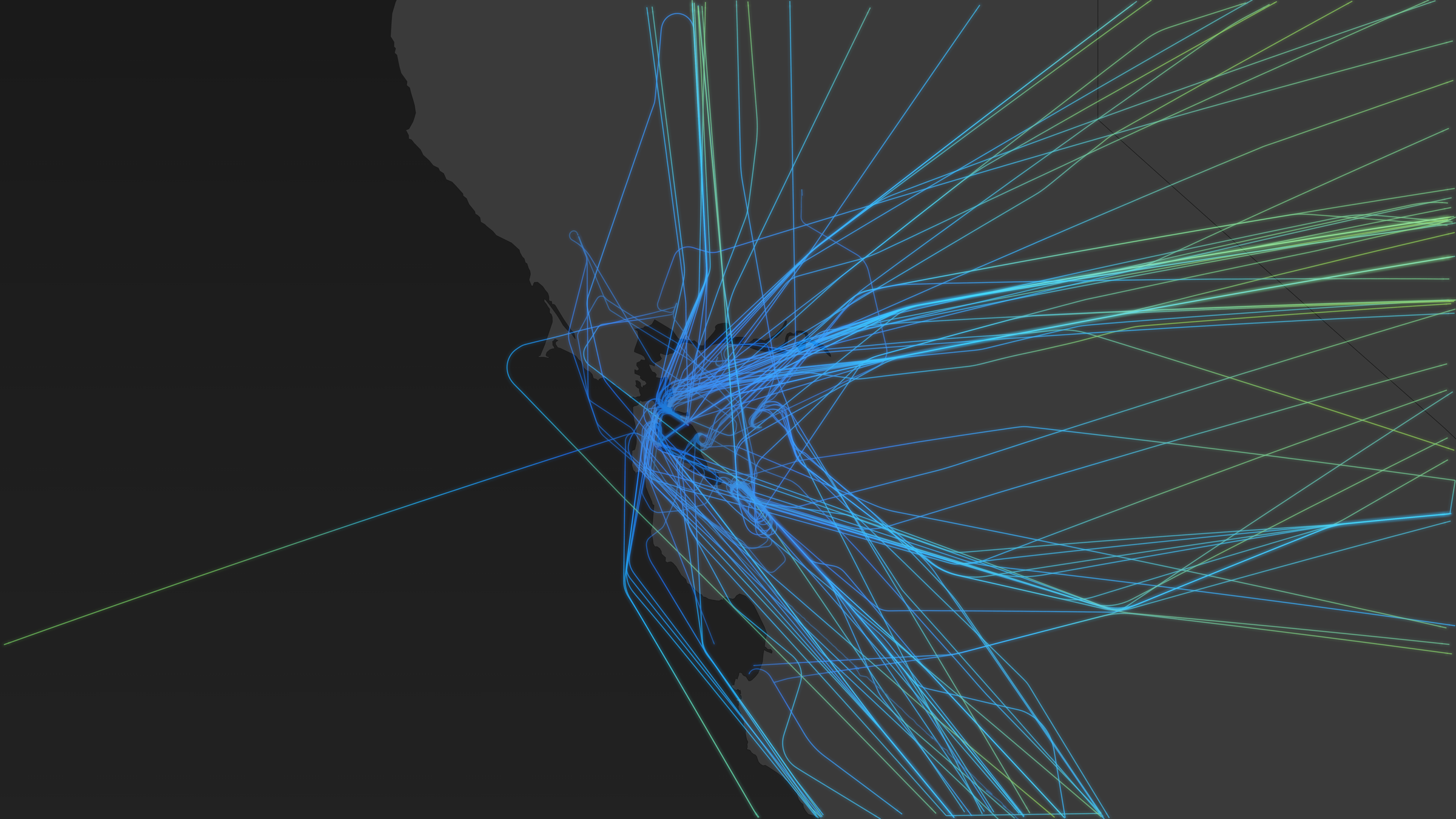
To establish context, we compared Super Bowl Sunday traffic to a baseline Sunday one week prior (February 1). That evening saw just 8 aircraft departures. The Super Bowl surge represented a 1,550% increase—from 8 to 132 planes. Total distance flown jumped from 2,115 to 159,365 nautical miles.
We tracked only US-registered aircraft using ADS-B transponder data. International-registered aircraft and flights without active transponders would not appear in this analysis, meaning actual departures were likely higher.
The Fleet
The departing aircraft represented a cross-section of long-range business aviation. Gulfstream models dominated with 38 departures, while Bombardier business jets accounted for 50 flights. The most common model was the Bombardier Challenger 350, with 16 departures.
The longest journey covered 3,220 nautical miles (3,705 statute miles), requiring ultra-long-range capabilities. The average flight covered 1,181 nautical miles with an average duration of just over three hours.
The Pattern
Super Bowl LX continued a pattern we've documented at previous championship games: major sporting events generate measurable spikes in private aviation activity. The Bay Area's multiple business aviation airports—San Francisco, Oakland, San Jose, Hayward, Livermore, and smaller facilities—handled the departure surge across their infrastructure.
The data offers a window into how private aviation responds to large-scale events, with aircraft positioning in advance and departing in concentrated waves once the game concludes.
![Flight Density Map - January 25, 2026, 12:00-04:00 UTC]](https://cdn.sanity.io/images/tktrs3g8/production/b4c0e1f314f298bc8875b3b9dbf1ea81fb2b3dda-7560x3240.png?rect=1188,0,5184,3240&w=800&h=500)