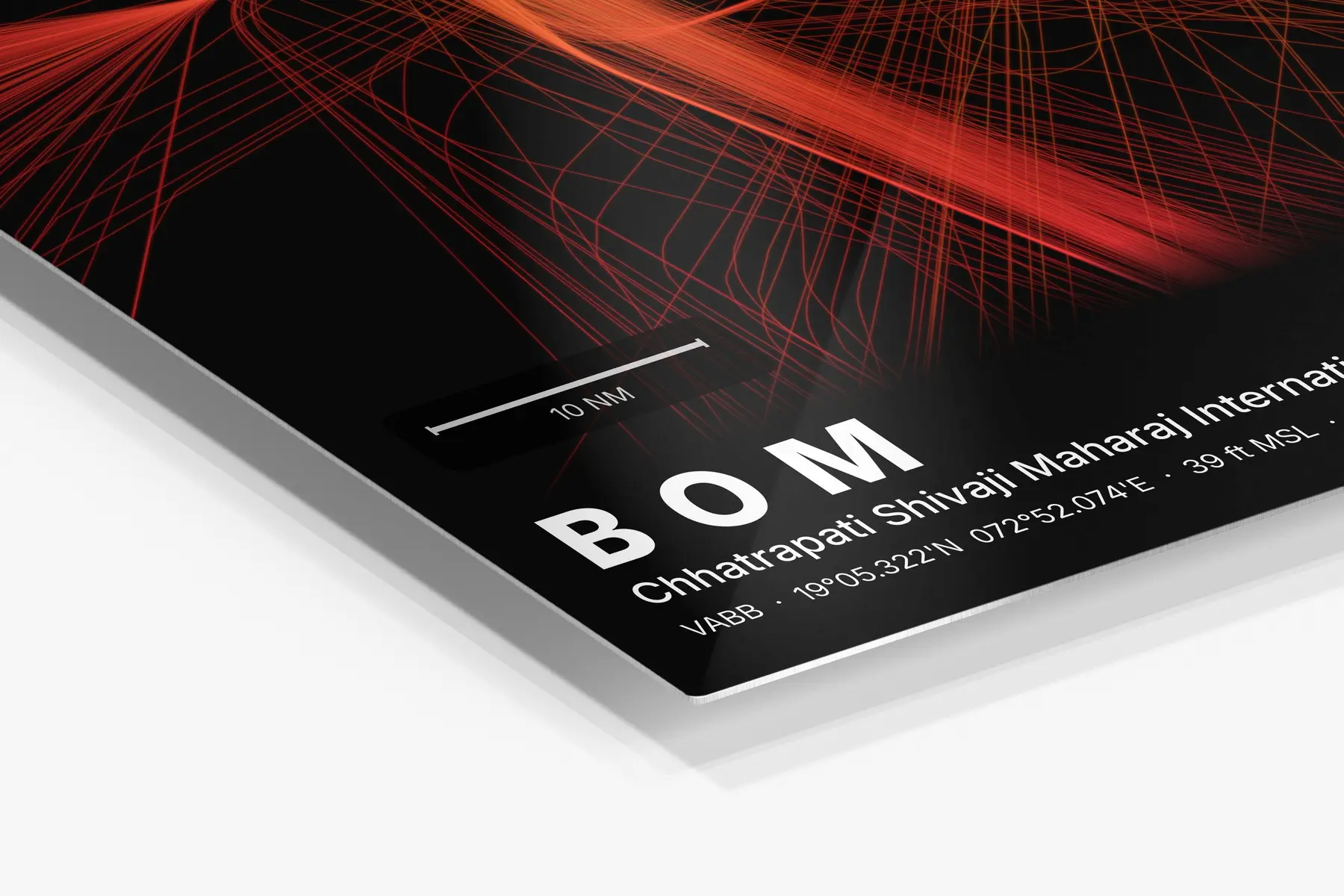
BOM

Chhatrapati Shivaji Maharaj International Airport

Chhatrapati Shivaji Maharaj International Airport (BOM) is one of India's busiest aviation gateways, linking Mumbai — the country's financial capital — to destinations across Asia, the Middle East, Europe, and beyond. This metal print captures that relentless connectivity through real ADS-B flight tracking data. Each flight path is colorized by altitude, rendered across your chosen palette.

This print visualizes all 742 flights recorded on February 3, 2026 — the 12th anniversary of the second runway becoming operational. Printed direct-to-metal on an aluminum panel, it is a piece of aviation wall art that commemorates the day BOM's capacity took flight.

BOM flight path print — Aurora theme in living-room setting [hotspot:46]BOM flight path print — Aurora theme in office setting [hotspot:55]BOM flight path print — Ember theme in living-room setting [hotspot:46]BOM flight path print — Ember theme in office setting [hotspot:55]BOM flight path print — Nebula theme in living-room setting [hotspot:46]BOM flight path print — Nebula theme in office setting [hotspot:55]BOM flight path print — Solstice theme in living-room setting [hotspot:46]BOM flight path print — Solstice theme in office setting [hotspot:55]BOM flight path print — Sky theme in living-room setting [hotspot:46]BOM flight path print — Sky theme in office setting [hotspot:55]BOM flight path print — Coast theme in living-room setting [hotspot:46]BOM flight path print — Coast theme in office setting [hotspot:55]BOM flight path print — Rose theme in living-room setting [hotspot:46]BOM flight path print — Rose theme in office setting [hotspot:55]BOM flight path print — Iris theme in living-room setting [hotspot:46]BOM flight path print — Iris theme in office setting [hotspot:55]

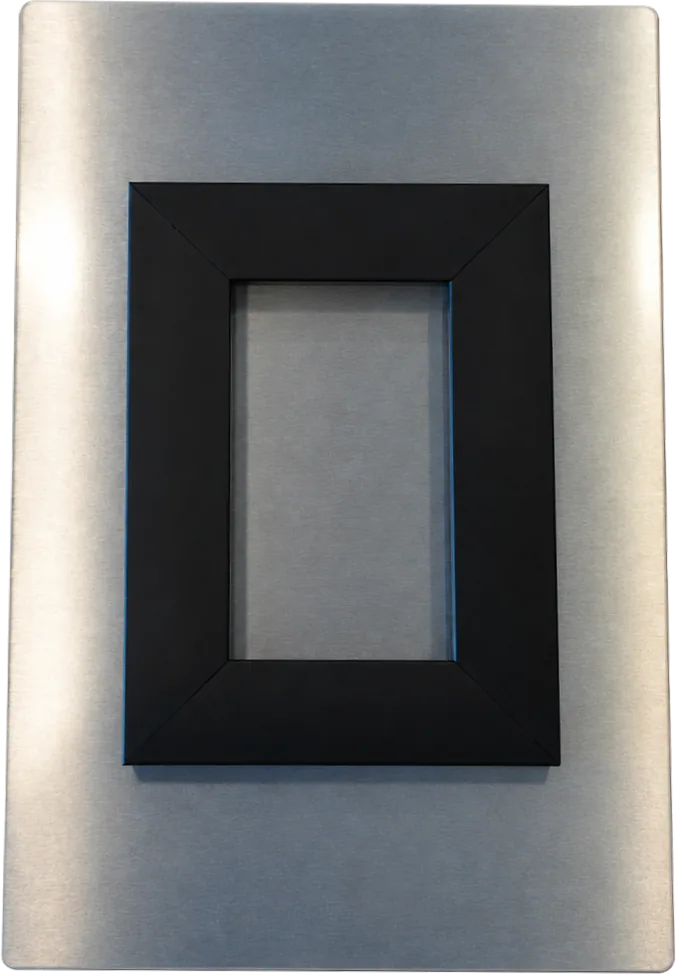
Dye-sublimated on aluminum · Float mount hardware included

$119

Made to order in 2–3 daysMade in the USA
Behind the Print

Statistics from the ADS-B flight data visualized in this print.

742

Total Flights

283

Unique Aircraft

40

Peak Hour Flights

This page captures ADS-B radar data for Chhatrapati Shivaji Maharaj International Airport (BOM/VABB) on February 3, 2026, the 12th anniversary of the airport's second runway becoming operational. Over the course of the day, 742 total flights were recorded, comprising 476 arrivals, 262 departures, and 4 touch-and-goes, operated by 283 unique aircraft. Traffic ran across all 24 hours, with the first and last flights logged at 00:00 and 23:59 IST respectively. The peak hour was 11:00 IST with 40 movements, and the average across the day held at 30.9 flights per hour. Arrivals outnumbered departures in most hours, most sharply around midnight when hour 0 logged 33 arrivals against just 1 departure. Daman Airport (NMB) was the busiest paired airport at 83 total movements, followed by Kempegowda International in Bengaluru at 56 and Aurangabad at 38. Navi Mumbai International Airport produced the shortest recorded flight, an arrival covering 17.1 nautical miles in 10 minutes with a maximum altitude of 4,150 feet. The longest flight was an arrival spanning 2,728.7 nautical miles over 320.4 minutes, operated by G-YMMT, a UK-registered aircraft. The highest-altitude flight reached 46,475 feet, flown by M-ARDI, also UK-registered. Approach traffic came predominantly from the NNE (106 counts) and ENE (87 counts), while departures favored N (56) and ENE (44). The altitude distribution across 274,470 ADS-B position points shows heavy concentration in the 1,000 to 2,000 foot band (37,351 points), consistent with approach and departure activity close to the airport. Cruise traffic clusters around 37,000 to 38,000 feet (7,770 points) and 39,000 to 40,000 feet (6,413 points). Average groundspeed across all flights was 290 knots, with a maximum of 611.7 knots recorded. Indian-registered aircraft made up the large majority of the fleet at 204 of 283 unique aircraft, with UAE, UK, Thai, and other international registrations rounding out the mix across 27 countries.

Every print includes a QR code linking to the full flight report.

Full Flight Report
Aluminum print showing flight path visualization
Premium Material

Why Aluminum

Our prints are produced on museum-grade aluminum with a high-gloss finish — the choice of professional galleries worldwide.

Dye-Sublimated

Colors infused directly into the aluminum surface for unmatched vibrancy.

Deep Blacks & Vibrant Color

High-gloss finish delivers exceptional contrast and altitude gradients.

Archival Durability

Scratch-resistant, waterproof, and fade-resistant for decades of display.

Modern Float Mount

Included mounting hardware creates a sleek 3/4" float off the wall.

Gallery-Quality Finish

The same premium process used by museums and professional galleries.

About the Airport

Chhatrapati Shivaji Maharaj International Airport sits in the Santacruz suburb of Mumbai, roughly 30 kilometers north of the city center. Civil aviation operations at the site date to the 1940s, with the airport serving both domestic and international traffic for decades under various names before being renamed in honor of the 17th-century Maratha emperor. It operates under the ICAO code VABB and the widely recognized IATA code BOM.

The airport handles an enormous volume of traffic for a facility constrained by its urban setting. Mumbai is India's commercial and financial capital, and BOM reflects that status — it consistently ranks among the top airports in India by passenger throughput. For years, the airport operated with a single runway, a significant bottleneck. A second runway became operational in February 2014, meaningfully increasing capacity and reducing delays. The two runways, designated 09/27 and 14/32, are oriented to accommodate the region's wind patterns and approach geometry within a tight geographic footprint.

The airport is a hub for Air India and IndiGo, and hosts a broad range of international carriers connecting Mumbai to the Gulf, Southeast Asia, Europe, and North America. Terminal 2, opened in 2014, consolidated international and select domestic operations under one roof and is widely noted for its scale and design. The older Terminal 1 handles additional domestic traffic. BOM's position reflects Mumbai's dual role as a global business center and a major origin-destination market — a city that generates its own demand rather than functioning primarily as a transit point. That distinction shapes the character of the traffic flowing through the airport every day.