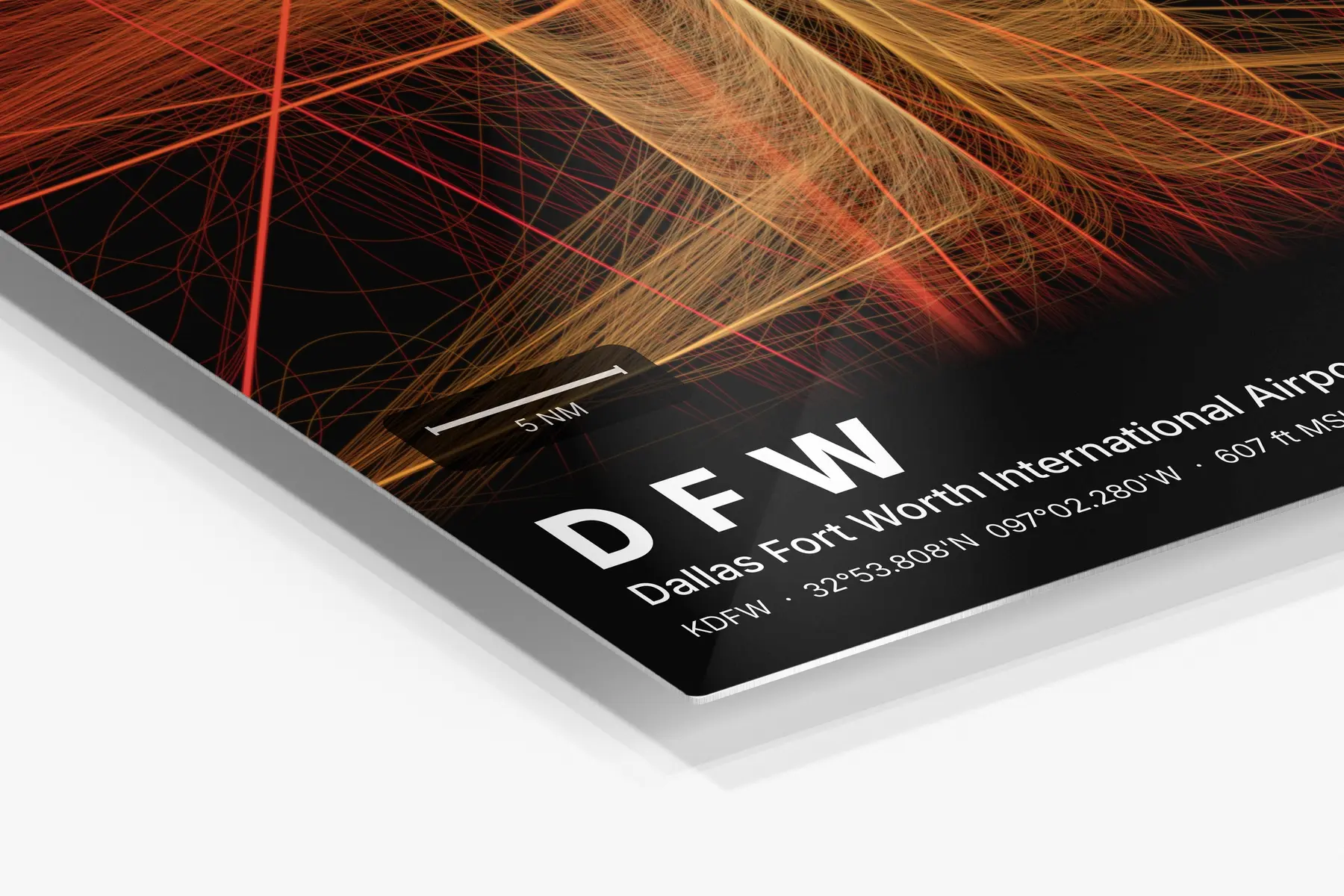
DFW

Dallas Fort Worth International Airport

Dallas Fort Worth International Airport (DFW) is one of the most connected hubs in the world, linking the American interior to nearly every major market across six continents. This metal print captures that reach — built from real ADS-B flight tracking data. Every flight path is colorized by altitude across your chosen palette.

This print visualizes all 1,856 flights recorded on August 11, 2025 — the 20th anniversary of Terminal D's opening at DFW. Printed direct-to-metal on an aluminum panel, it is a piece of aviation wall art that locks one of the busiest days in American skies to a milestone worth remembering.

DFW flight path print — Inferno theme · Dark in living-room setting [hotspot:46]DFW flight path print — Inferno theme · Dark in office setting [hotspot:55]DFW flight path print — Solana theme · Dark in living-room setting [hotspot:46]DFW flight path print — Solana theme · Dark in office setting [hotspot:55]DFW flight path print — Citrus theme · Dark in living-room setting [hotspot:46]DFW flight path print — Citrus theme · Dark in office setting [hotspot:55]DFW flight path print — Blossom theme · Dark in living-room setting [hotspot:46]DFW flight path print — Blossom theme · Dark in office setting [hotspot:55]DFW flight path print — Prism theme · Dark in living-room setting [hotspot:46]DFW flight path print — Prism theme · Dark in office setting [hotspot:55]DFW flight path print — Inferno theme · Light in living-room setting [hotspot:46]DFW flight path print — Inferno theme · Light in office setting [hotspot:55]DFW flight path print — Solana theme · Light in living-room setting [hotspot:46]DFW flight path print — Solana theme · Light in office setting [hotspot:55]DFW flight path print — Citrus theme · Light in living-room setting [hotspot:46]DFW flight path print — Citrus theme · Light in office setting [hotspot:55]DFW flight path print — Blossom theme · Light in living-room setting [hotspot:46]DFW flight path print — Blossom theme · Light in office setting [hotspot:55]DFW flight path print — Prism theme · Light in living-room setting [hotspot:46]DFW flight path print — Prism theme · Light in office setting [hotspot:55]

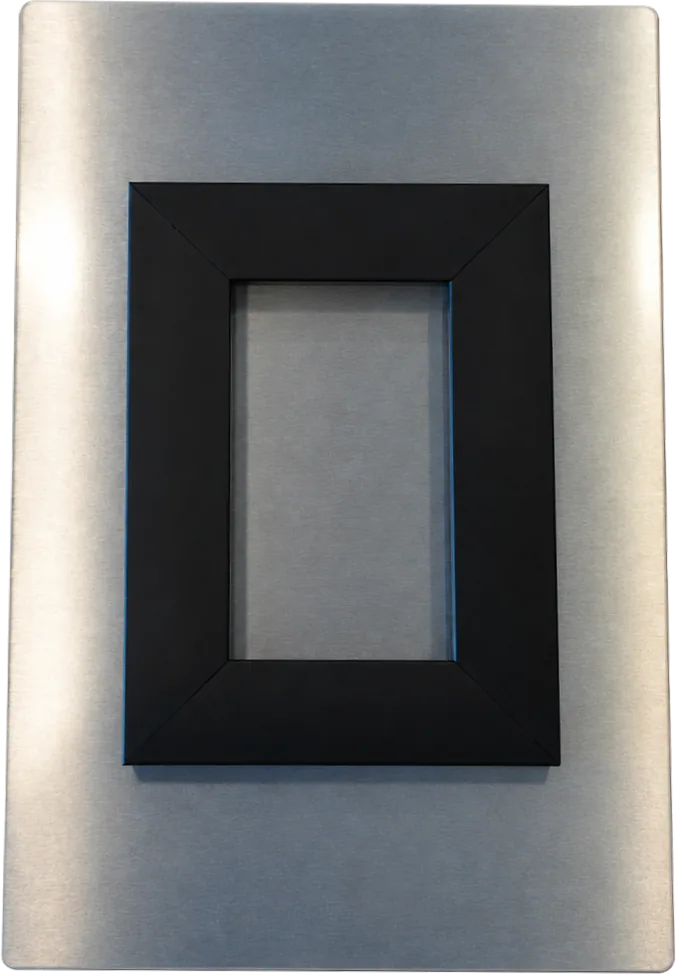
Dye-sublimated on aluminum · Float mount hardware included

$119

Made to order in 2–3 daysMade in the USA
Behind the Print

Every ADS-B-tracked flight visualized in this print — captured on a single day.

1,856

Total Flights

652

Unique Aircraft

1,339,357

ADS-B Points

Traffic data for Dallas Fort Worth International Airport (DFW) was captured on August 11, 2025, the 20th anniversary of Terminal D's opening. The dataset covers a full 24-hour period in CDT and logs 1,856 total flights across 975 arrivals and 881 departures, drawn from 652 unique aircraft. Operations ran continuously from midnight through 23:59, with activity never fully stopping. The busiest hour was 17:00 CDT, which recorded 137 movements (50 arrivals, 87 departures). A secondary surge appears at 22:00, where departures reached 89 against only 18 arrivals. The quietest stretch ran between 02:00 and 04:00, each hour logging fewer than 15 total movements. Route data identifies Houston Intercontinental (IAH) as the top connection with 35 total movements, followed closely by LaGuardia (LGA) and Atlanta (ATL) at 34 each, and Chicago O'Hare (ORD) at 33. Los Angeles (LAX), Denver (DEN), and Miami (MIA) round out the upper tier. The predominant approach and departure direction was ENE at 162 counts each, with NE and NW also appearing across both flow categories. Aircraft registered in the United States made up 621 of the 652 unique aircraft observed, with Canada (6), and smaller counts from China, Finland, Turkey, Australia, and others accounting for the remainder. Altitude data spans 1.34 million ADS-B position points, with an average tracked altitude of 18,732 feet and a peak of 49,300 feet recorded by N954JS on a flight from Naples Municipal (APF). The 36,000 to 39,000 foot range shows the highest concentration of cruise-level data points. The longest tracked flight covered 4,012.5 nautical miles over 814 minutes, connecting to Boston Logan (BOS). Average leg distance was 722.4 nautical miles at an average duration of 117.7 minutes, with a total of 1,340,827 nautical miles flown across all tracked movements.

Every print includes a QR code linking to the full flight report.

Full Flight Report
Aluminum print showing flight path visualization
Premium Material

Why Aluminum

Our prints are produced on museum-grade aluminum with a high-gloss finish — the choice of professional galleries worldwide.

Dye-Sublimated

Colors infused directly into the aluminum surface for unmatched vibrancy.

Deep Blacks & Vibrant Color

High-gloss finish delivers exceptional contrast and altitude gradients.

Archival Durability

Scratch-resistant, waterproof, and fade-resistant for decades of display.

Modern Float Mount

Included mounting hardware creates a sleek 3/4" float off the wall.

Gallery-Quality Finish

The same premium process used by museums and professional galleries.

About the Airport

Dallas Fort Worth International Airport opened on January 13, 1974, replacing Love Field as the primary commercial gateway for the Dallas–Fort Worth metroplex. It was conceived as a regional solution to a longstanding rivalry between the two cities, designed from the outset to be expandable — a rare quality in airport planning at the time.

Geographically, DFW sits almost exactly between Dallas and Fort Worth, straddling Tarrant and Dallas counties along the Interstate 635 corridor. That central position is more than symbolic. The airport operates as one of American Airlines' two primary hubs, and the carrier's dominance here is substantial — American accounts for the overwhelming majority of the airport's traffic. Routes extend to destinations across North America, Latin America, Europe, and the Pacific.

The airport's layout is defined by a series of semicircular terminals arranged along an international parkway spine, a design intended to minimize walking distances while allowing private vehicle access to each terminal. Terminal D, which opened in 2005, brought international capacity and a direct rail connection via the Skylink people mover that loops the entire terminal complex. DFW covers roughly 17,207 acres, making it one of the largest airports by land area in the world. It consistently ranks among the top 10 busiest airports globally by passenger volume and aircraft operations. For the region, it functions as both an economic engine and the primary point of connection to long-haul international markets that Love Field, constrained by the Wright Amendment for decades, could never serve.