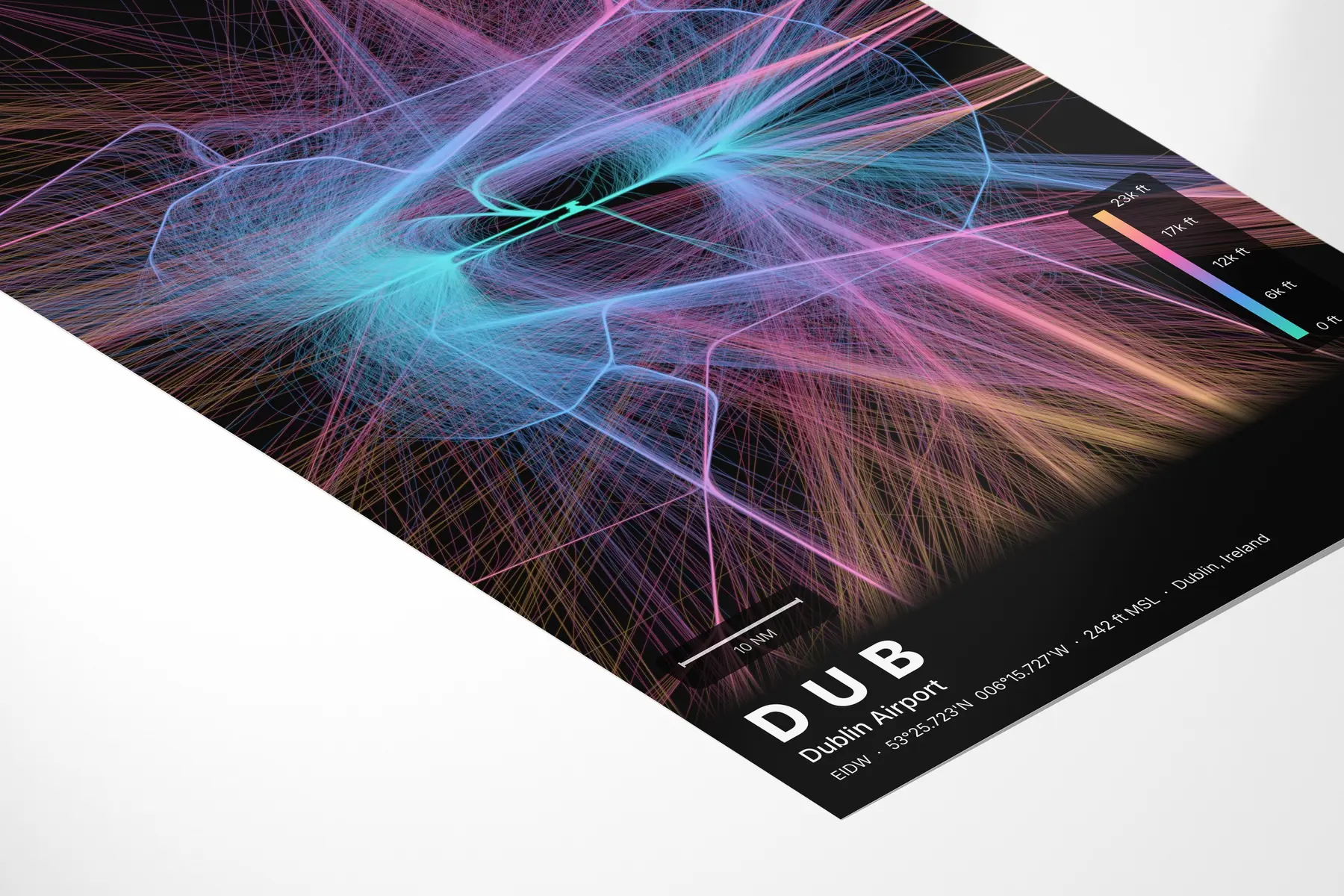
Arrivals and departures, traced from ADS-B data.
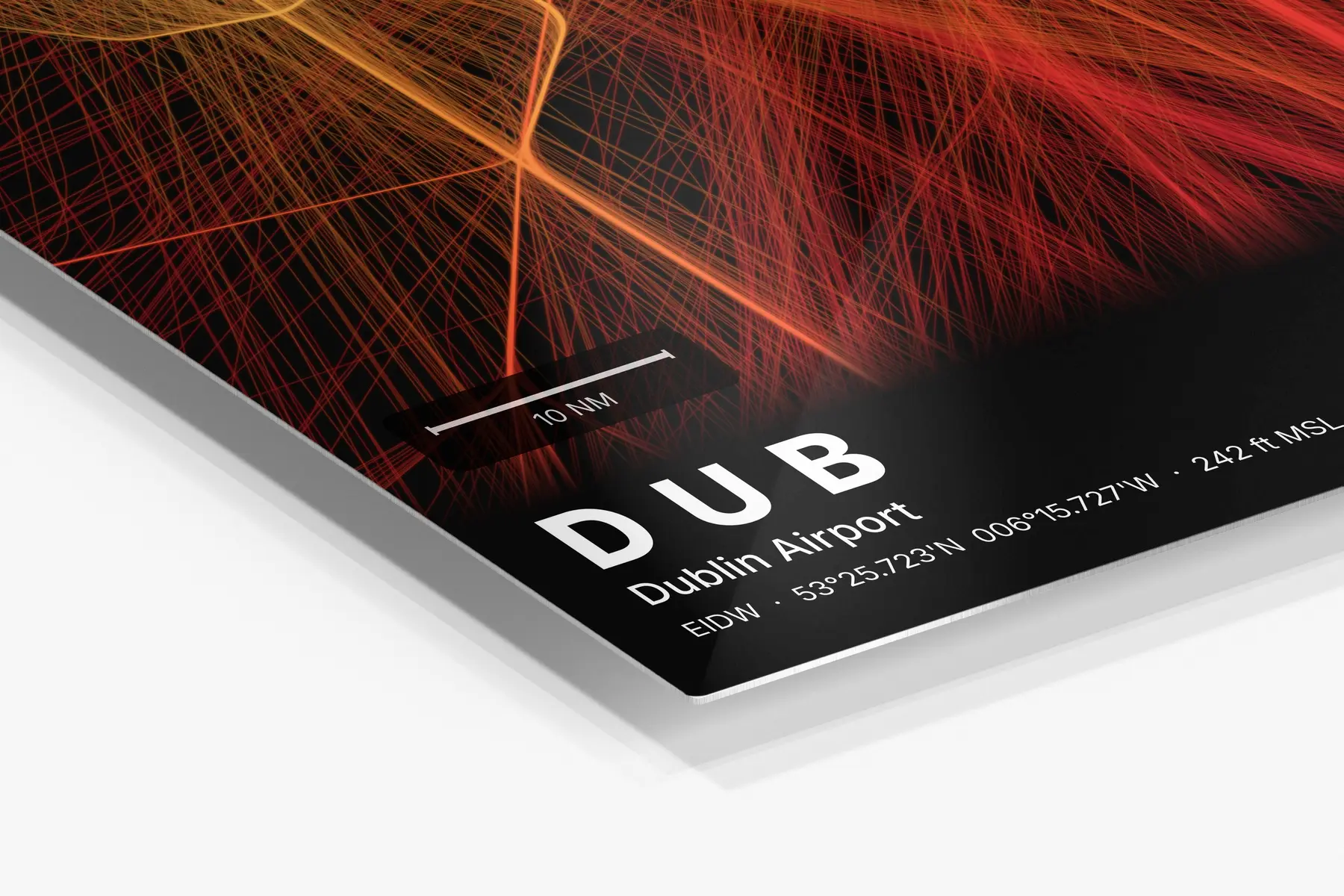
Museum-quality gloss aluminum · fade-resistant · ready to hang.
From $119
![DUB flight path print — Inferno theme · Dark in office setting [hotspot:55]](https://cdn.shopify.com/s/files/1/0818/7710/6930/files/office_ad257399-d34a-4626-b39a-6bbc5c908d7c.webp?v=1783017797&width=3840)
![DUB flight path print — Inferno theme · Dark in living-room setting [hotspot:46]](https://cdn.shopify.com/s/files/1/0818/7710/6930/files/living-room_6ad41fff-3e43-4c98-ba6c-81b0038c9425.webp?v=1783017794&width=3840)

Arrivals and departures, traced from ADS-B data.
Museum-quality gloss aluminum · fade-resistant · ready to hang.
Dublin Airport (DUB) is Ireland's main international airport, connecting the country to Europe, North America, and beyond. This metal print captures that reach in detail, built from ADS-B flight tracking data. Every flight path is colorized by altitude across your chosen palette.
This print visualizes all 4,797 flights recorded April 28-May 4, 2026, on the 68th anniversary of Aer Lingus's inaugural transatlantic flight linking Dublin to New York. Each one tracked, rendered, and printed direct-to-metal on an aluminum panel: a permanent record of one week's traffic through one of aviation's busiest gateways, timed to the date it all began.
$119
Free U.S. shipping
What's included
Dublin Airport (DUB) is Ireland's main international airport, connecting the country to Europe, North America, and beyond. This metal print captures that reach in detail, built from ADS-B flight tracking data. Every flight path is colorized by altitude across your chosen palette.
This print visualizes all 4,797 flights recorded April 28-May 4, 2026, on the 68th anniversary of Aer Lingus's inaugural transatlantic flight linking Dublin to New York. Each one tracked, rendered, and printed direct-to-metal on an aluminum panel: a permanent record of one week's traffic through one of aviation's busiest gateways, timed to the date it all began.

Our prints are produced on museum-quality aluminum with a high-gloss finish, the same material professional galleries use.
Colors infused directly into the aluminum surface, not printed on top.
High-gloss finish holds sharp contrast across the altitude gradients.
Scratch-resistant, waterproof, and fade-resistant for decades of display.
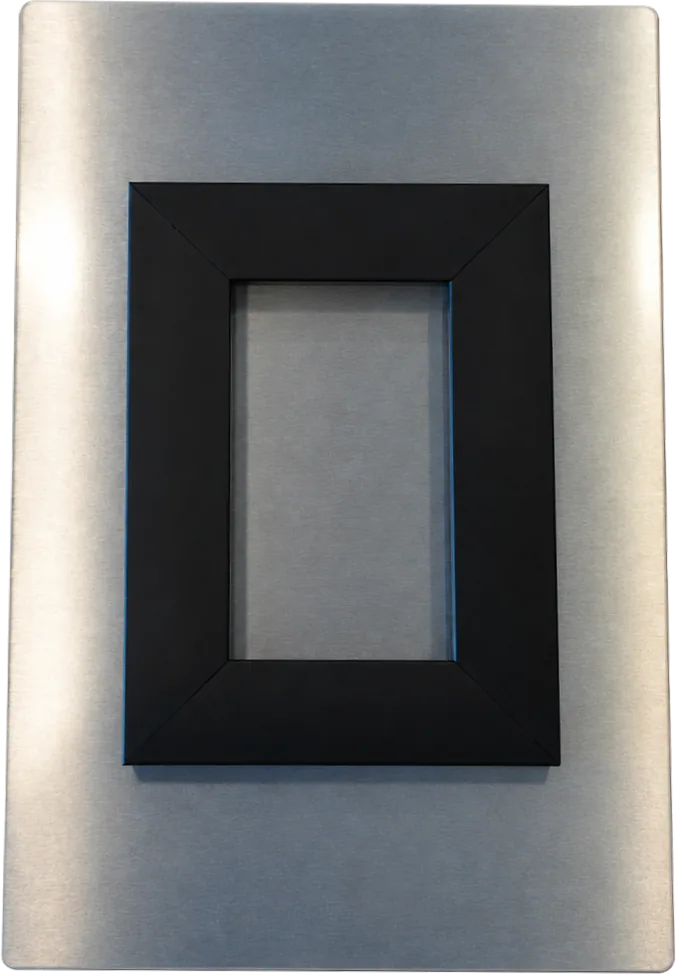
Included mounting hardware creates a sleek 3/4" float off the wall.
Drop your email — we'll send your code and a heads-up when we add new airports.
Every ADS-B-tracked flight visualized in this print, captured over 7 days.
4,797
Total Flights
816
Unique Aircraft
4,112,540
ADS-B Points
Dublin Airport logged 4,797 flights across seven days from April 28 to May 4, 2026, averaging 685 movements per day and 28.6 per hour. Arrivals and departures split almost evenly at 2,404 and 2,393 respectively. The busiest single day was May 1, with 777 total movements. Activity ran around the clock, with the first recorded flight at midnight and the last at 23:35 IST. The 07:00 hour was the peak of the week, generating 362 movements, heavily skewed toward departures at 232 versus 130 arrivals. From 08:00 through 18:00 the airport sustained between 233 and 322 movements per hour. After midnight, traffic dropped sharply, with just 2 total movements recorded in the 02:00 hour. London Heathrow was the busiest route pair at 225 combined movements, followed by Amsterdam Schiphol at 167 and Manchester at 166. Edinburgh, London Stansted, Birmingham, Paris CDG, London Gatwick, Malaga, and Glasgow rounded out the top ten. Approach and departure tracks were concentrated in the ESE and E quadrants, with ESE accounting for 719 arrivals and 716 departures. The 816 unique aircraft observed came from registrations across 31 countries, with Croatia (HR) leading at 222 aircraft, followed by the United States at 82 and Italy at 79. The longest recorded flight connected Dublin to Dubai International at 3,681.8 nautical miles over 475.8 minutes. The highest altitude reached during the capture window was 49,600 feet, on an arrival from Munich. Cruise altitudes clustered heavily between 37,000 and 38,000 feet, the single most populated band in the dataset. Average groundspeed across all flights was 255 knots, with a recorded maximum of 696.8 knots.
Every print includes a QR code linking to the flight stats.
Reviews from customers across our airport print collection.
Great gift to commemorate trip!
We ordered the LHR image (aurora/light) as a gift for our son who is in college and training to be a commercial airline pilot. We had taken a family trip to London and this was the perfect gift for him. He loved the image, and immediately scanned the included QR code to review the flight data that is available to support each map. The quality and delivery timing were exceptional. We will definitely order more!
LHR · London Heathrow
Response from SkyPath Studio
Thank you for your review, Nathan! We wish your son the best on his journey to becoming a pilot.
Dublin Airport opened on January 19, 1940, when an Aer Lingus Lockheed 14 departed what was then called Collinstown Airport for Liverpool. It was a modest beginning: one flight a day, grass runways, and a terminal designed to handle just 100,000 passengers a year. That original terminal, designed by architect Desmond FitzGerald, was modeled on the tiered lines of an ocean liner and won the Royal Hibernian Institute of Architects Triennial Gold Medal in 1942. It is today a listed building.
World War II effectively mothballed the airport until 1945. Recovery was swift. By 1947, KLM had inaugurated continental European service to Dublin, and 1958 brought the defining moment in the airport's history: on April 28, Aerlínte Éireann, the predecessor of modern Aer Lingus, operated its inaugural transatlantic service from Dublin and Shannon to New York, making Ireland one of the first nations outside North America with a scheduled transatlantic connection. Passenger numbers topped 1 million by 1963, and Terminal 1 opened in 1972 to absorb the growth.
Today, DUB is the busiest airport on the island of Ireland and recorded over 36.4 million passengers in 2025, its busiest year on record. It is the primary hub for Aer Lingus and the home base for Ryanair, Europe's largest airline. Terminal 2, which opened in November 2010, consolidated all transatlantic operations and houses one of only a handful of U.S. Customs and Border Protection preclearance facilities outside North America, allowing passengers to clear U.S. immigration before departure. A new North Runway opened in August 2022, the airport's first new runway in over three decades, running parallel to and significantly longer than the main existing runway.