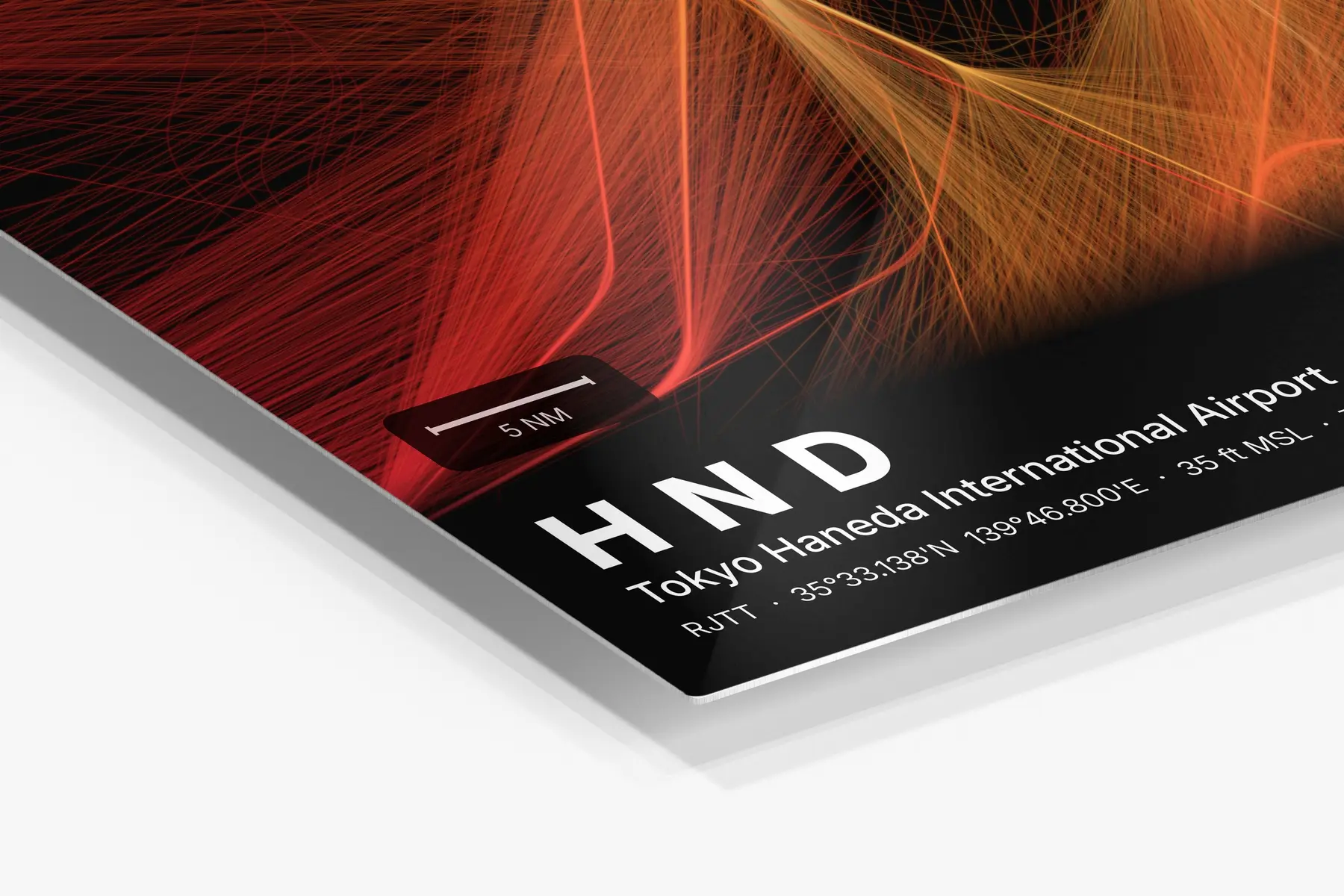
HND

Tokyo Haneda International Airport

Tokyo Haneda International Airport (HND) is one of Asia's most connected hubs, linking central Tokyo to domestic routes across Japan and international gateways across the Pacific and beyond. This metal print captures that reach — drawn from real ADS-B flight tracking data. Every path is colorized by altitude, rendered across your chosen palette.

This print visualizes all 1,256 flights recorded on September 2, 2025 — the 80th anniversary of US occupation forces taking control of the airport. Printed direct-to-metal on an aluminum panel, it is a piece of aviation wall art that holds a defining moment in HND's history.

HND flight path print — Inferno theme · Dark in living-room setting [hotspot:46]HND flight path print — Inferno theme · Dark in office setting [hotspot:55]HND flight path print — Solana theme · Dark in living-room setting [hotspot:46]HND flight path print — Solana theme · Dark in office setting [hotspot:55]HND flight path print — Citrus theme · Dark in living-room setting [hotspot:46]HND flight path print — Citrus theme · Dark in office setting [hotspot:55]HND flight path print — Blossom theme · Dark in living-room setting [hotspot:46]HND flight path print — Blossom theme · Dark in office setting [hotspot:55]HND flight path print — Prism theme · Dark in living-room setting [hotspot:46]HND flight path print — Prism theme · Dark in office setting [hotspot:55]HND flight path print — Inferno theme · Light in living-room setting [hotspot:46]HND flight path print — Inferno theme · Light in office setting [hotspot:55]HND flight path print — Solana theme · Light in living-room setting [hotspot:46]HND flight path print — Solana theme · Light in office setting [hotspot:55]HND flight path print — Citrus theme · Light in living-room setting [hotspot:46]HND flight path print — Citrus theme · Light in office setting [hotspot:55]HND flight path print — Blossom theme · Light in living-room setting [hotspot:46]HND flight path print — Blossom theme · Light in office setting [hotspot:55]HND flight path print — Prism theme · Light in living-room setting [hotspot:46]HND flight path print — Prism theme · Light in office setting [hotspot:55]

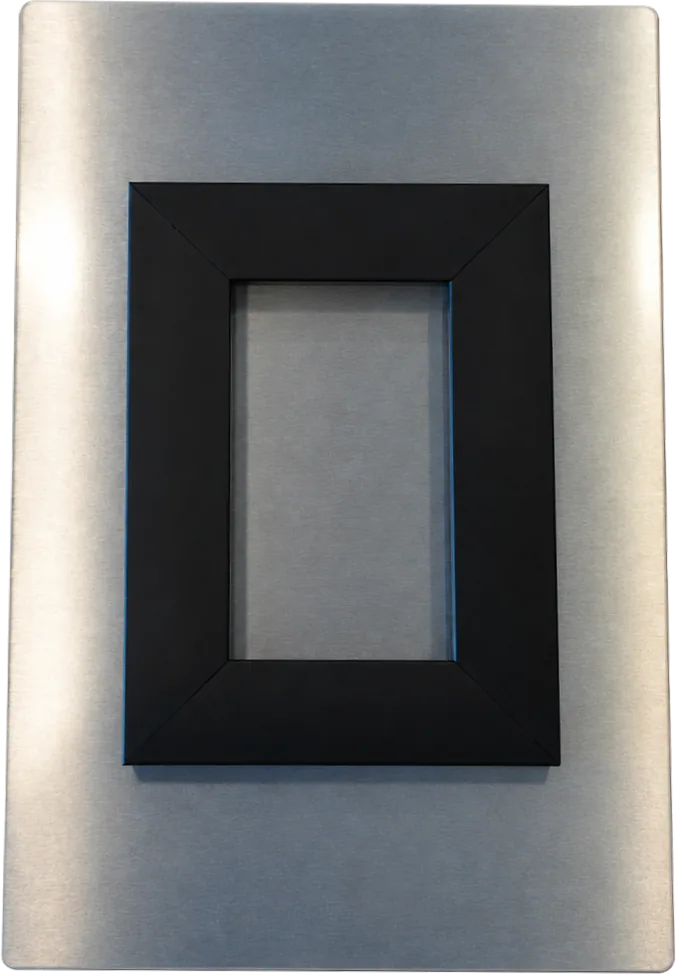
Dye-sublimated on aluminum · Float mount hardware included

$119

Made to order in 2–3 daysMade in the USA
Behind the Print

Every ADS-B-tracked flight visualized in this print — captured on a single day.

1,256

Total Flights

388

Unique Aircraft

716,256

ADS-B Points

Traffic data for Tokyo Haneda International Airport (HND/RJTT) covers September 2, 2025, a date marking the 80th anniversary of US occupation forces taking control of the airfield. ADS-B receivers captured 716,256 position points across 1,256 total movements, split exactly between 628 arrivals and 628 departures, operated by 388 unique aircraft. The busiest hour was 20:00 JST with 86 flights, 43 in each direction. Traffic stayed active across the full 24-hour period, though the overnight hours between 01:00 and 05:00 JST carried fewer than 12 movements per hour. The morning departure push at 07:00 JST produced 47 outbound flights against only 10 arrivals, while the evening window from 17:00 through 21:00 JST showed the heaviest sustained arrival load. Oita Airport (OIT) topped the route list with 108 combined movements, heavily skewed toward arrivals at 87. Iwami Airport (IWJ) and Iwakuni Kintaikyo Airport (IWK) each appeared exclusively on the departure side, with 46 and 44 departures respectively and zero arrivals recorded. Osaka Itami (ITM) and Sendai (SDJ) showed more balanced two-way traffic. All top ten routes were domestic Japanese airports. Approach directions were dominated by WSW at 258 arrivals, followed by NNE at 87 and W at 83. Departures showed a similar western lean, with WSW at 199 and W at 169. The aircraft fleet was 300 Japanese-registered aircraft out of 388 unique tail counts, with Chinese registrations second at 28 and US registrations third at 14. Altitude data peaked at 47,575 feet, with the highest-altitude flight arriving from Oita, and the average groundspeed across all tracked flights was 262 knots.

Every print includes a QR code linking to the full flight report.

Full Flight Report
Aluminum print showing flight path visualization
Premium Material

Why Aluminum

Our prints are produced on museum-grade aluminum with a high-gloss finish — the choice of professional galleries worldwide.

Dye-Sublimated

Colors infused directly into the aluminum surface for unmatched vibrancy.

Deep Blacks & Vibrant Color

High-gloss finish delivers exceptional contrast and altitude gradients.

Archival Durability

Scratch-resistant, waterproof, and fade-resistant for decades of display.

Modern Float Mount

Included mounting hardware creates a sleek 3/4" float off the wall.

Gallery-Quality Finish

The same premium process used by museums and professional galleries.

About the Airport

Tokyo Haneda International Airport opened in 1931 as Tokyo's first civil aerodrome, built on reclaimed land along the southwestern shore of Tokyo Bay. It quickly became the primary gateway to the Japanese capital. After World War II, US occupation forces took control of the airport on September 2, 1945 — the same day Japan signed the instrument of surrender — repurposing it exclusively for military use before returning it to civilian operations in stages through the 1950s and 1960s.

HND sits roughly 14 kilometers south of central Tokyo, closer to the city than Narita International Airport, which handles much of Tokyo's long-haul international traffic. That proximity made Haneda the preferred airport for domestic travel and, increasingly, short-haul international routes across Asia. The airport operates 4 runways and serves as a primary hub for Japan Airlines and All Nippon Airways.

A major expansion completed in 2010 added a new international terminal and extended operating hours, allowing long-haul international services to return to HND after decades of being concentrated at Narita. The airport's layout is distinctive — 3 of its 4 runways extend over Tokyo Bay on reclaimed land, a design driven by the constraint of operating within a dense urban environment. Haneda consistently ranks among the busiest airports in the world by passenger volume, and it is widely recognized for operational efficiency and cleanliness. For travelers entering Tokyo, it remains the faster, more central option.