Tokyo Haneda International Airport
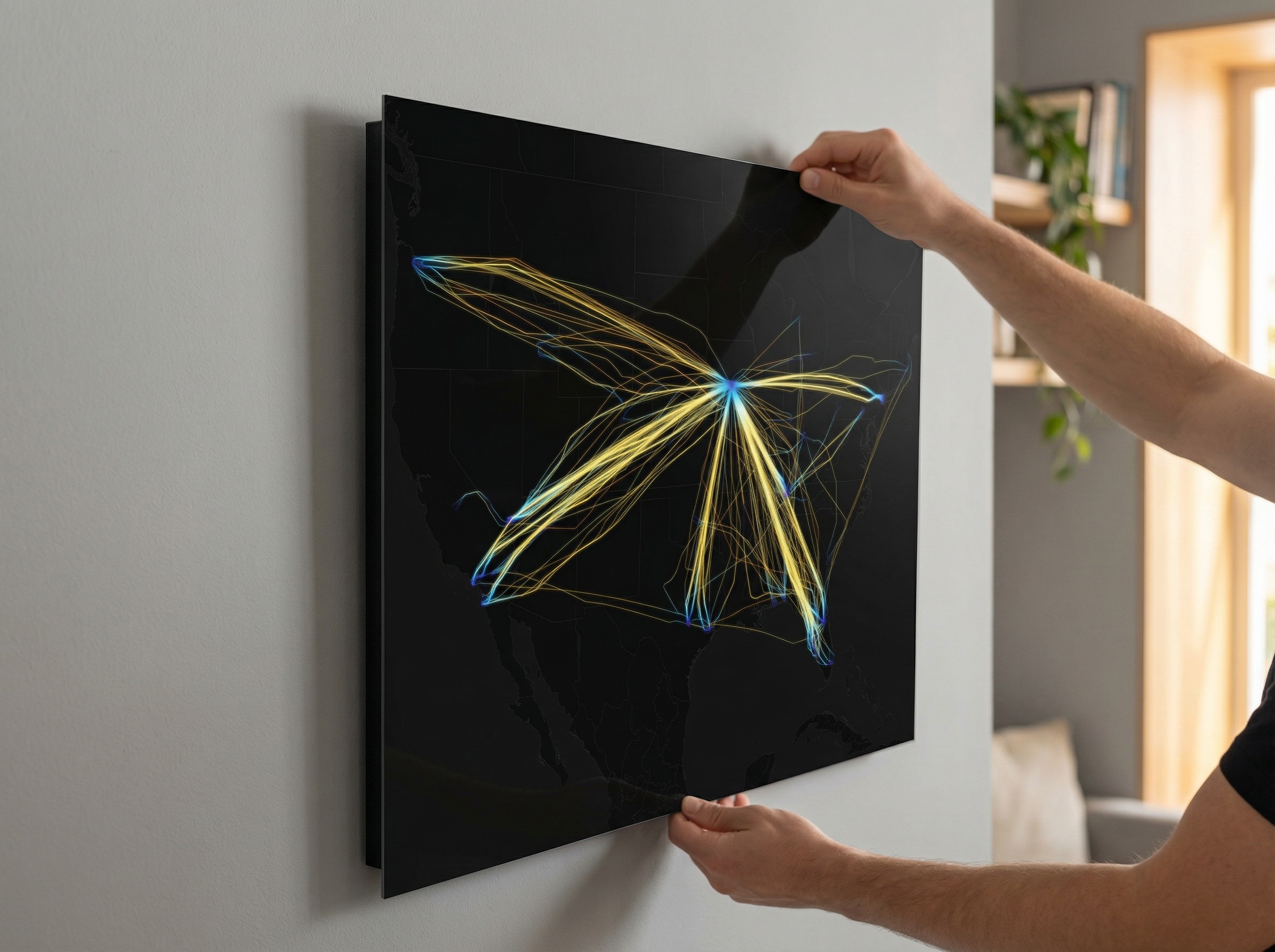
Tokyo Haneda International Airport (HND) is one of Asia's most active aviation hubs, sitting on reclaimed land in Tokyo Bay and connecting Japan's capital to domestic and international destinations alike. Real ADS-B data captures every flight path precisely. Each trace is colorized by altitude, rendered across whichever palette you choose.
This print visualizes all 1,308 flights recorded on October 21, 2025 — the 47th anniversary of HND's transition to primarily domestic operations. Printed direct-to-metal on an aluminum panel, it is a piece of aviation wall art that fixes one of Japan's most consequential aviation milestones into something permanent.
![HND flight path print — Aurora theme in living-room setting [hotspot:46]](https://cdn.shopify.com/s/files/1/0818/7710/6930/files/living-room_31d098bf-9943-4706-86ba-d502eeb824b3.webp?v=1776111307&width=3840)
![HND flight path print — Aurora theme in office setting [hotspot:55]](https://cdn.shopify.com/s/files/1/0818/7710/6930/files/office_7ce883ef-0985-49d7-8e32-b20540d700df.webp?v=1776111309&width=3840)
![HND flight path print — Ember theme in living-room setting [hotspot:46]](https://cdn.shopify.com/s/files/1/0818/7710/6930/files/living-room_3a70f9a0-cd89-454c-be3b-ffeca011f661.webp?v=1776111312&width=3840)
![HND flight path print — Ember theme in office setting [hotspot:55]](https://cdn.shopify.com/s/files/1/0818/7710/6930/files/office_f60501b1-6c3d-43e7-887c-cf838eb0b9ef.webp?v=1776111314&width=3840)
![HND flight path print — Nebula theme in living-room setting [hotspot:46]](https://cdn.shopify.com/s/files/1/0818/7710/6930/files/living-room_a0c0b6d6-a760-43bf-8583-cb3528c297a1.webp?v=1776111317&width=3840)
![HND flight path print — Nebula theme in office setting [hotspot:55]](https://cdn.shopify.com/s/files/1/0818/7710/6930/files/office_eb315668-b10b-4ac1-8363-954b7ebd2587.webp?v=1776111319&width=3840)
![HND flight path print — Solstice theme in living-room setting [hotspot:46]](https://cdn.shopify.com/s/files/1/0818/7710/6930/files/living-room_5ede80e8-0303-4121-b04e-7d96e6aaadf4.webp?v=1776111323&width=3840)
![HND flight path print — Solstice theme in office setting [hotspot:55]](https://cdn.shopify.com/s/files/1/0818/7710/6930/files/office_d5d88354-6e17-446f-be48-11f10212505a.webp?v=1776111324&width=3840)
![HND flight path print — Sky theme in living-room setting [hotspot:46]](https://cdn.shopify.com/s/files/1/0818/7710/6930/files/living-room_e1bb2d60-0d68-4be5-9fd8-d7be4fd4010f.webp?v=1776111328&width=3840)
![HND flight path print — Sky theme in office setting [hotspot:55]](https://cdn.shopify.com/s/files/1/0818/7710/6930/files/office_7c92ef11-2a37-4ddc-9f23-0196ab8a0a2c.webp?v=1776111329&width=3840)
![HND flight path print — Coast theme in living-room setting [hotspot:46]](https://cdn.shopify.com/s/files/1/0818/7710/6930/files/living-room_2022db93-bdc9-40ec-9a11-6f1b7c138efa.webp?v=1776111333&width=3840)
![HND flight path print — Coast theme in office setting [hotspot:55]](https://cdn.shopify.com/s/files/1/0818/7710/6930/files/office_26089bd6-8855-42be-b36d-0fc366a72c2e.webp?v=1776111334&width=3840)
![HND flight path print — Rose theme in living-room setting [hotspot:46]](https://cdn.shopify.com/s/files/1/0818/7710/6930/files/living-room_e4ed4c79-5bf4-4b59-b4d1-79c1ed091df0.webp?v=1776111338&width=3840)
![HND flight path print — Rose theme in office setting [hotspot:55]](https://cdn.shopify.com/s/files/1/0818/7710/6930/files/office_8550f84d-3b31-4b22-aeb7-85d773d842bd.webp?v=1776111340&width=3840)
![HND flight path print — Iris theme in living-room setting [hotspot:46]](https://cdn.shopify.com/s/files/1/0818/7710/6930/files/living-room_d3fed783-ad19-4063-b61b-709bf6c3cce3.webp?v=1776111343&width=3840)
![HND flight path print — Iris theme in office setting [hotspot:55]](https://cdn.shopify.com/s/files/1/0818/7710/6930/files/office_7ebcdd05-8d77-4076-ba92-471e9a552711.webp?v=1776111344&width=3840)


Tokyo Haneda International Airport
Tokyo Haneda International Airport (HND) is one of Asia's most active aviation hubs, sitting on reclaimed land in Tokyo Bay and connecting Japan's capital to domestic and international destinations alike. Real ADS-B data captures every flight path precisely. Each trace is colorized by altitude, rendered across whichever palette you choose.
This print visualizes all 1,308 flights recorded on October 21, 2025 — the 47th anniversary of HND's transition to primarily domestic operations. Printed direct-to-metal on an aluminum panel, it is a piece of aviation wall art that fixes one of Japan's most consequential aviation milestones into something permanent.
Dye-sublimated on aluminum · Float mount hardware included
$119
Statistics from the ADS-B flight data visualized in this print.
1,308
Total Flights
406
Unique Aircraft
92
Peak Hour Flights
ADS-B radar data for Tokyo Haneda International Airport (HND/RJTT) captured on October 21, 2025 recorded 1,308 total flights across 24 hours, split almost evenly between 651 arrivals and 647 departures, with 10 touch-and-gos also logged. Traffic ran continuously from midnight to 23:59 JST. The peak hour was 08:00, which produced 92 movements, and the average across the day held at 54.5 flights per hour. Early morning hours between 01:00 and 05:00 saw the lightest activity, with single-digit or low double-digit totals. A total of 406 unique aircraft were tracked, 305 of which carried Japanese registrations. The remaining fleet spanned 23 other countries, with Chinese (28), American (23), and South Korean (7) registrations making up the next largest groups. Fukuoka was the busiest paired airport at 61 combined movements, followed by Osaka Itami at 59 and Yamaguchi Ube at 58. Matsuyama accounted for 43 movements, all arrivals. The top ten routes were entirely domestic Japanese destinations. Approach directions were dominated by WSW at 286 recorded approaches, with NNE (87) and W (83) as the next most frequent. Departure traffic spread more evenly, with WSW (193) and W (185) nearly tied at the top, followed by N (91). The altitude data spans 614,724 ADS-B position points. The most populated altitude band was 0 to 1,000 feet with 84,989 points, reflecting the volume of traffic in terminal phases. Cruise-level concentrations appeared at 33,000 to 34,000 feet (19,910 points), 31,000 to 32,000 feet (15,174 points), and 35,000 to 36,000 feet (14,016 points). The highest recorded altitude was 47,625 feet, on an arrival from Hong Kong International Airport flown by an Italian-registered aircraft. The longest flight by distance was also an arrival from Hong Kong at 1,676.8 nautical miles and 211.6 minutes. Average groundspeed across all tracked flights was 309 knots, with a maximum of 633.4 knots recorded.
Every print includes a QR code linking to the full flight report.
Why Aluminum
Our prints are produced on museum-grade aluminum with a high-gloss finish — the choice of professional galleries worldwide.
Dye-Sublimated
Colors infused directly into the aluminum surface for unmatched vibrancy.
Deep Blacks & Vibrant Color
High-gloss finish delivers exceptional contrast and altitude gradients.
Archival Durability
Scratch-resistant, waterproof, and fade-resistant for decades of display.
Modern Float Mount
Included mounting hardware creates a sleek 3/4" float off the wall.
Gallery-Quality Finish
The same premium process used by museums and professional galleries.
About the Airport
Tokyo Haneda International Airport, designated RJTT and known by its IATA code HND, opened in 1931 as Tokyo's first commercial airfield. It sits on reclaimed land along the northwestern shore of Tokyo Bay, roughly 14 kilometers south of central Tokyo. That proximity to the city center has always been its defining advantage over the region's other major hub, Narita International Airport.
For much of its postwar history, Haneda served as Japan's primary international gateway. That changed in 1978, when Narita opened and international scheduled services were largely transferred there. HND was redirected to domestic routes, and for decades it became the busiest domestic airport in Asia by passenger volume. The airport handles an extraordinary concentration of short-haul traffic, with All Nippon Airways and Japan Airlines operating dense shuttle services between Tokyo and cities including Sapporo, Osaka, Fukuoka, and Okinawa.
International services returned to the airport in 2010, initially limited to overnight slots before expanding significantly in 2014 and again in 2020 with the opening of a new international terminal facility. Today, the airport operates 4 runways and handles tens of millions of passengers annually, making it one of the busiest airports in the world. Its location within the urban fabric of Tokyo — reachable by monorail and subway — gives it a connectivity that few airports anywhere can match. The surrounding reclaimed land means approaches and departures cross directly over the bay, a routing that shapes the distinctive arc of flight paths visible in any data visualization of the airport.