Miami International Airport
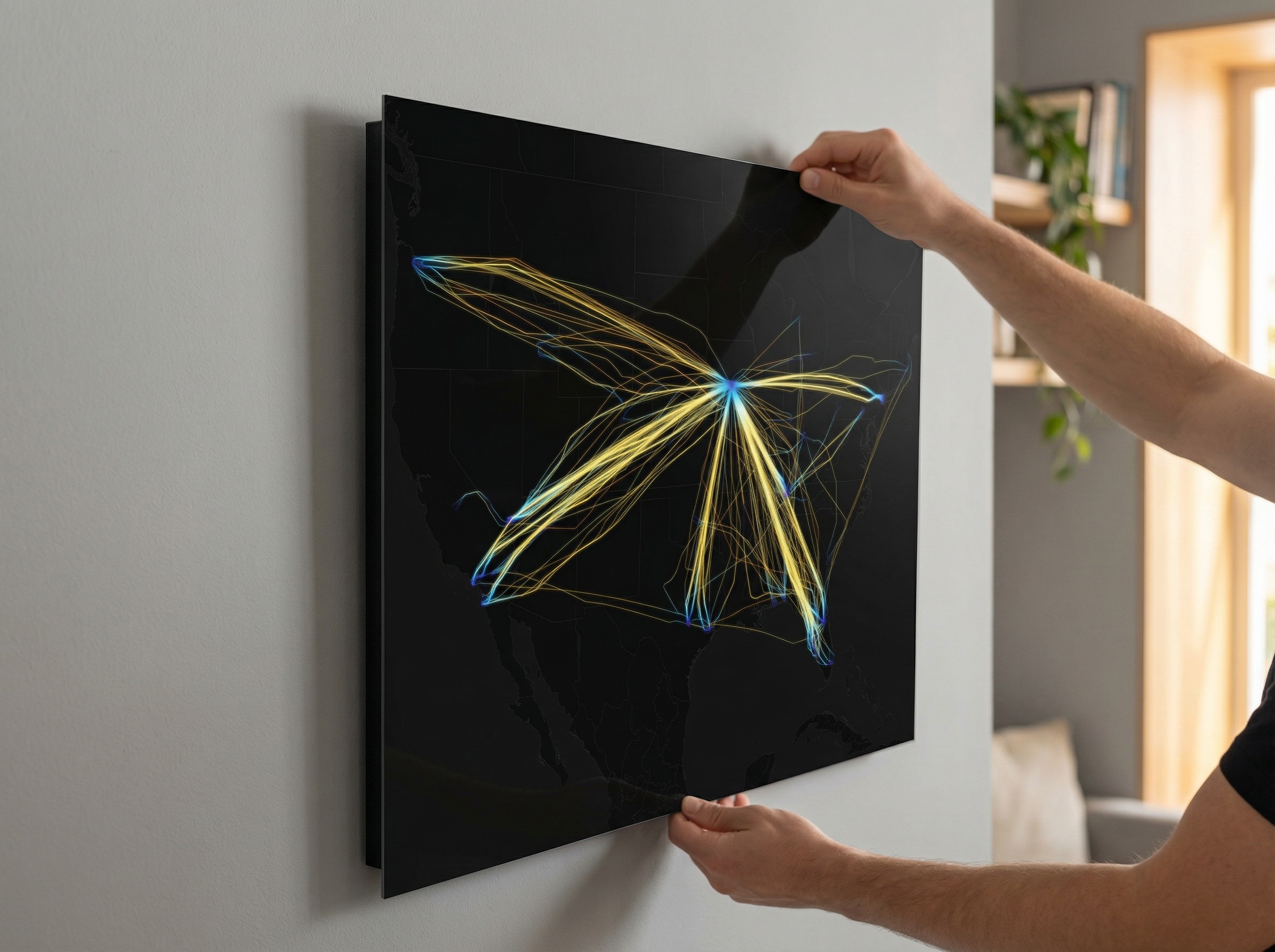
Miami International Airport (MIA) is one of the busiest international gateways in the United States, linking the Americas, the Caribbean, and beyond. This metal print captures that reach — drawn from real ADS-B flight tracking data. Each flight path is colorized by altitude across your chosen palette.
This print visualizes all 51 flights recorded on December 20–21, 2025 — the 80th anniversary of the airport's renaming to Miami International Airport. Printed direct-to-metal on an aluminum panel, it is a piece of aviation wall art that ties a living day of flight to the moment MIA got its name.
![MIA flight path print — Inferno theme · Dark in living-room setting [hotspot:46]](https://cdn.shopify.com/s/files/1/0818/7710/6930/files/living-room_cec50104-39aa-4461-9896-4157e00c3fa1.webp?v=1779154266&width=3840)
![MIA flight path print — Inferno theme · Dark in office setting [hotspot:55]](https://cdn.shopify.com/s/files/1/0818/7710/6930/files/office_60969cf1-92df-49f8-8ced-ce7d5cc99d13.webp?v=1779154268&width=3840)
![MIA flight path print — Solana theme · Dark in living-room setting [hotspot:46]](https://cdn.shopify.com/s/files/1/0818/7710/6930/files/living-room_a99a150a-0cba-442a-b8c3-b3be9f2a607d.webp?v=1779154271&width=3840)
![MIA flight path print — Solana theme · Dark in office setting [hotspot:55]](https://cdn.shopify.com/s/files/1/0818/7710/6930/files/office_68be23e9-642c-4a25-b6ab-6ef008fbb968.webp?v=1779154272&width=3840)
![MIA flight path print — Citrus theme · Dark in living-room setting [hotspot:46]](https://cdn.shopify.com/s/files/1/0818/7710/6930/files/living-room_a3a695ae-604c-41f0-8bbd-a206b60a884c.webp?v=1779154276&width=3840)
![MIA flight path print — Citrus theme · Dark in office setting [hotspot:55]](https://cdn.shopify.com/s/files/1/0818/7710/6930/files/office_6fe47ff4-6c72-483b-b6d6-f9d76cc00579.webp?v=1779154277&width=3840)
![MIA flight path print — Blossom theme · Dark in living-room setting [hotspot:46]](https://cdn.shopify.com/s/files/1/0818/7710/6930/files/living-room_fae5a327-0a3a-42ab-84a8-a05c2be9bdc0.webp?v=1779154281&width=3840)
![MIA flight path print — Blossom theme · Dark in office setting [hotspot:55]](https://cdn.shopify.com/s/files/1/0818/7710/6930/files/office_1265cacb-e8cd-43ed-9499-743593d7835a.webp?v=1779154282&width=3840)
![MIA flight path print — Prism theme · Dark in living-room setting [hotspot:46]](https://cdn.shopify.com/s/files/1/0818/7710/6930/files/living-room_f14a833c-73dc-4abf-be28-c30eaac6a3df.webp?v=1779154285&width=3840)
![MIA flight path print — Prism theme · Dark in office setting [hotspot:55]](https://cdn.shopify.com/s/files/1/0818/7710/6930/files/office_7c5d42cb-8783-4a5b-8eac-987f60dcf912.webp?v=1779154287&width=3840)
![MIA flight path print — Inferno theme · Light in living-room setting [hotspot:46]](https://cdn.shopify.com/s/files/1/0818/7710/6930/files/living-room_397eb582-7220-4194-9cf1-c40e048fb613.webp?v=1779154290&width=3840)
![MIA flight path print — Inferno theme · Light in office setting [hotspot:55]](https://cdn.shopify.com/s/files/1/0818/7710/6930/files/office_a2c2284c-b54a-47bf-9387-add11170c40d.webp?v=1779154292&width=3840)
![MIA flight path print — Solana theme · Light in living-room setting [hotspot:46]](https://cdn.shopify.com/s/files/1/0818/7710/6930/files/living-room_c85d9296-6ddb-4131-b4a9-e9a505df9519.webp?v=1779154295&width=3840)
![MIA flight path print — Solana theme · Light in office setting [hotspot:55]](https://cdn.shopify.com/s/files/1/0818/7710/6930/files/office_378d2f29-03ec-45f6-9770-e1a32f9bcca9.webp?v=1779154297&width=3840)
![MIA flight path print — Citrus theme · Light in living-room setting [hotspot:46]](https://cdn.shopify.com/s/files/1/0818/7710/6930/files/living-room_808d78c8-795c-4385-8d03-55b0058ede02.webp?v=1779154300&width=3840)
![MIA flight path print — Citrus theme · Light in office setting [hotspot:55]](https://cdn.shopify.com/s/files/1/0818/7710/6930/files/office_14d1f5c6-4753-4328-8609-424a5a18f852.webp?v=1779154301&width=3840)
![MIA flight path print — Blossom theme · Light in living-room setting [hotspot:46]](https://cdn.shopify.com/s/files/1/0818/7710/6930/files/living-room_427f3875-5350-40d6-a8bc-5ca427d4a094.webp?v=1779154305&width=3840)
![MIA flight path print — Blossom theme · Light in office setting [hotspot:55]](https://cdn.shopify.com/s/files/1/0818/7710/6930/files/office_d313540b-eabf-4fc2-b49d-b72c596df78d.webp?v=1779154306&width=3840)
![MIA flight path print — Prism theme · Light in living-room setting [hotspot:46]](https://cdn.shopify.com/s/files/1/0818/7710/6930/files/living-room_db2e2bab-e5a0-4bd1-b018-1588cea5f71d.webp?v=1779154309&width=3840)
![MIA flight path print — Prism theme · Light in office setting [hotspot:55]](https://cdn.shopify.com/s/files/1/0818/7710/6930/files/office_657f7343-c116-453e-97c6-36ede4593f24.webp?v=1779154311&width=3840)


Miami International Airport
Miami International Airport (MIA) is one of the busiest international gateways in the United States, linking the Americas, the Caribbean, and beyond. This metal print captures that reach — drawn from real ADS-B flight tracking data. Each flight path is colorized by altitude across your chosen palette.
This print visualizes all 51 flights recorded on December 20–21, 2025 — the 80th anniversary of the airport's renaming to Miami International Airport. Printed direct-to-metal on an aluminum panel, it is a piece of aviation wall art that ties a living day of flight to the moment MIA got its name.
Dye-sublimated on aluminum · Float mount hardware included
$119
Every ADS-B-tracked flight visualized in this print — captured over 2 days.
51
Total Flights
48
Unique Aircraft
32,365
ADS-B Points
This dataset covers ADS-B traffic at Miami International Airport (MIA/KMIA) across two days, December 20 and 21, 2025, captured on the 80th anniversary of the airport's renaming. Across the window, 51 total flights were recorded involving 48 unique aircraft, split between 29 arrivals and 22 departures, plus 4 ground operations. December 21 was considerably busier, accounting for 37 of those 51 flights compared to just 14 on the 20th. The busiest single hour was 02:00 EST, which logged 7 flights, all arrivals. A second cluster of activity appeared in the early morning hours from 01:00 through 06:00, heavily weighted toward arrivals, while departures were more spread across the afternoon and evening hours from 07:00 onward. Approach traffic came most frequently from the SSE (7 flights) and WNW (6 flights), with NNW and ESE each contributing smaller shares. Departures scattered more broadly, with NNE and NW each seeing 4 outbound flights. The top route by total movements was Los Angeles (LAX) with 3 flights, followed by Atlanta (ATL) with 2. All other identified routes recorded a single flight. The longest flight in the dataset was an arrival from Seattle-Tacoma (SEA) covering 2,401 nautical miles in just over 5 hours. The shortest was an 8-minute departure to Miami Executive Airport (TMB), 25 nautical miles away. Altitude data spans from ground level up to a peak of 42,925 feet, reached by tail number N127QS on a departure to Monmouth Executive Airport (BLM). The average observed altitude across all ADS-B points was 21,885 feet. The 34,000 to 35,000 foot band was the most densely sampled, logging 2,806 position points, followed by the 36,000 to 37,000 foot range at 1,959 points. Average groundspeed across the dataset was 354 knots, with a maximum of 617.8 knots recorded. Total distance across all flights was 42,307.8 nautical miles. Of the 48 aircraft with identifiable registrations, 43 were US-registered.
Every print includes a QR code linking to the full flight report.
Why Aluminum
Our prints are produced on museum-grade aluminum with a high-gloss finish — the choice of professional galleries worldwide.
Dye-Sublimated
Colors infused directly into the aluminum surface for unmatched vibrancy.
Deep Blacks & Vibrant Color
High-gloss finish delivers exceptional contrast and altitude gradients.
Archival Durability
Scratch-resistant, waterproof, and fade-resistant for decades of display.
Modern Float Mount
Included mounting hardware creates a sleek 3/4" float off the wall.
Gallery-Quality Finish
The same premium process used by museums and professional galleries.
About the Airport
Miami International Airport traces its roots to Pan American Field, a facility developed in the late 1920s to support Pan American Airways' early routes into Latin America and the Caribbean. The airport was formally renamed Miami International Airport in December 1945, marking a shift toward broader commercial ambitions. It sits roughly 8 miles northwest of downtown Miami, just above sea level on land that was once Everglades fringe — a location that shapes both its weather exposure and its operational geography.
MIA has grown into one of the most internationally connected airports in North America. It consistently ranks as the top U.S. gateway for passengers traveling to and from Latin America and the Caribbean, a distinction rooted in both geography and airline strategy. American Airlines operates its largest international hub here, accounting for a significant share of the airport's capacity. LATAM, Avianca, and dozens of other international carriers maintain a strong presence as well.
The airport's layout is distinctive — a centralized terminal structure with concourses radiating outward, all connected under one roof. That design concentrates a high volume of connecting traffic through a compact footprint. Cargo is a core part of MIA's identity too; it regularly ranks among the top airports in the U.S. for international freight volume, particularly for perishables moving between North and South America.
Miami itself is inseparable from the airport's character. The city's role as a financial and cultural hub for the Western Hemisphere is reflected directly in MIA's route map — a dense web of connections that no other U.S. airport replicates at the same scale.