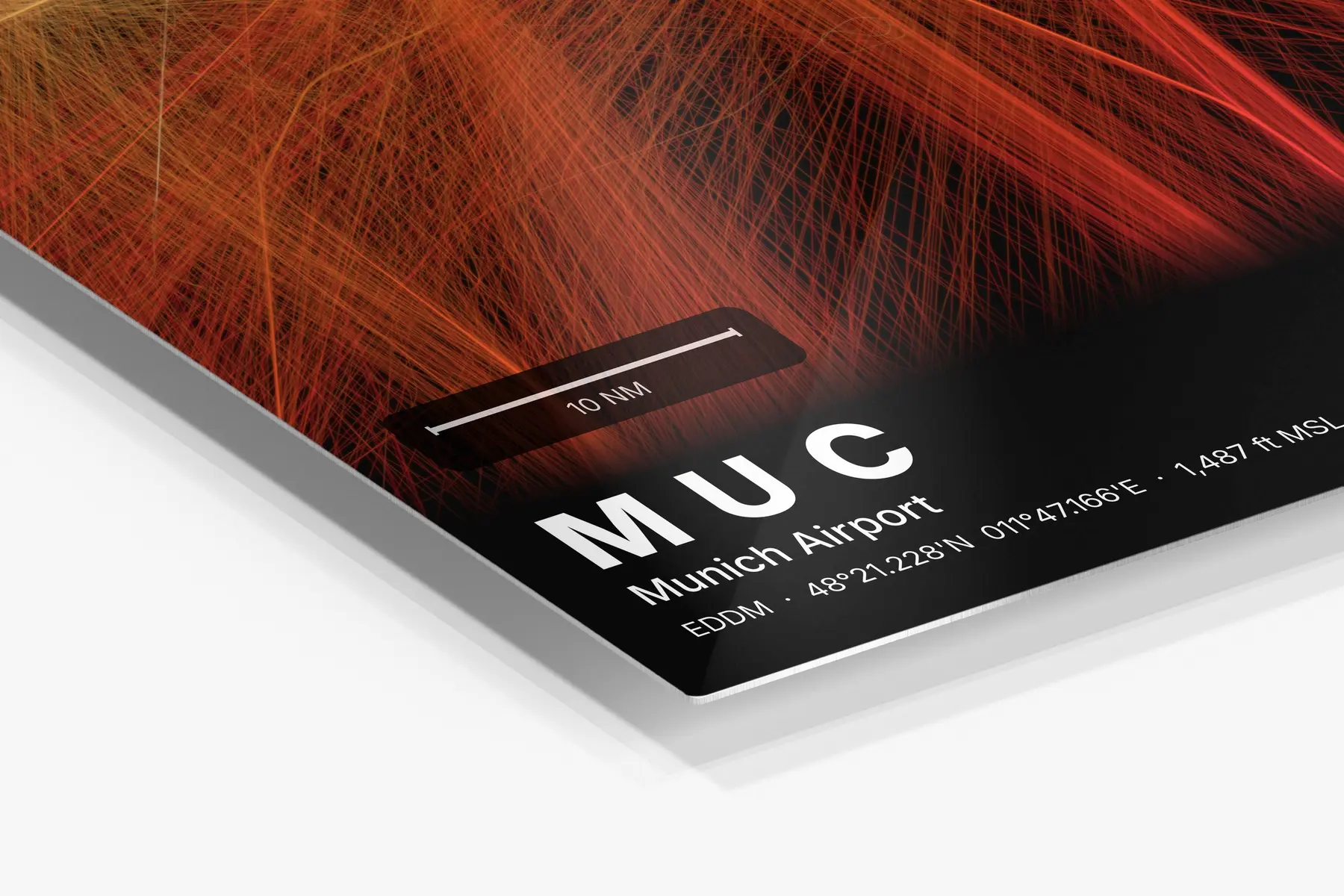
MUC

Munich Airport

Munich Airport (MUC) is one of Europe's principal long-haul gateways, connecting Bavaria to destinations across six continents. This metal print captures that reach — traced from real ADS-B flight tracking data. Each path is colorized by altitude across your chosen palette.

This print renders all 591 flights recorded on January 1, 2026, plotted in precise detail on a glossy aluminum panel. It is a piece of aviation wall art that fixes the first day of the year in flight — every departure, every arrival, every vector held permanently in place.

MUC flight path print — Aurora theme in living-room setting [hotspot:46]MUC flight path print — Aurora theme in office setting [hotspot:55]MUC flight path print — Ember theme in living-room setting [hotspot:46]MUC flight path print — Ember theme in office setting [hotspot:55]MUC flight path print — Nebula theme in living-room setting [hotspot:46]MUC flight path print — Nebula theme in office setting [hotspot:55]MUC flight path print — Solstice theme in living-room setting [hotspot:46]MUC flight path print — Solstice theme in office setting [hotspot:55]MUC flight path print — Sky theme in living-room setting [hotspot:46]MUC flight path print — Sky theme in office setting [hotspot:55]MUC flight path print — Coast theme in living-room setting [hotspot:46]MUC flight path print — Coast theme in office setting [hotspot:55]MUC flight path print — Rose theme in living-room setting [hotspot:46]MUC flight path print — Rose theme in office setting [hotspot:55]MUC flight path print — Iris theme in living-room setting [hotspot:46]MUC flight path print — Iris theme in office setting [hotspot:55]

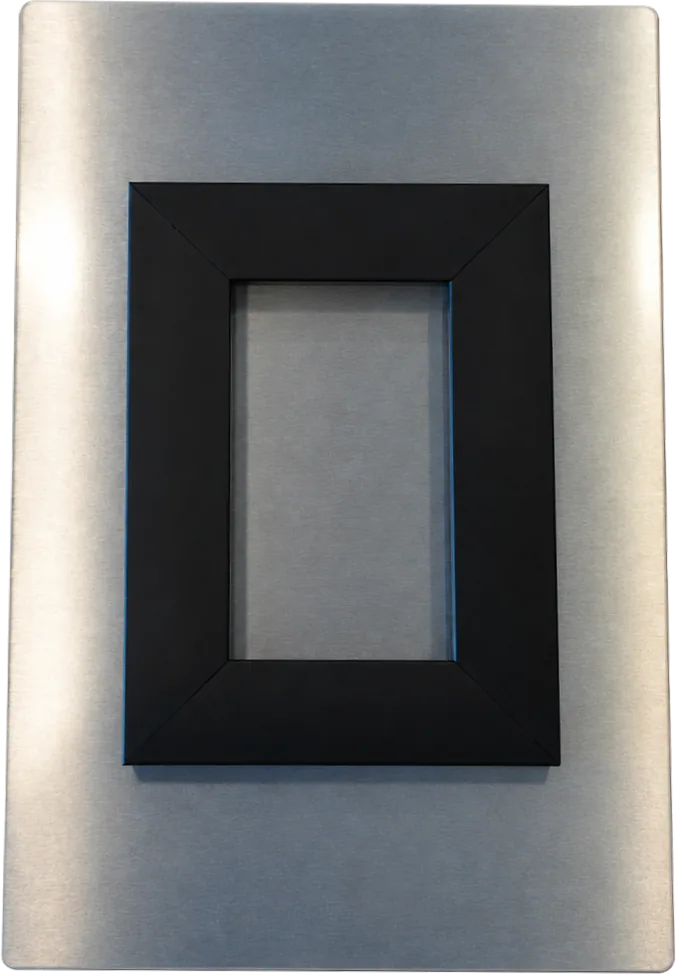
Dye-sublimated on aluminum · Float mount hardware included

$119

Made to order in 2–3 daysMade in the USA
Behind the Print

Statistics from the ADS-B flight data visualized in this print.

591

Total Flights

248

Unique Aircraft

49

Peak Hour Flights

ADS-B radar data captured 591 total flights at Munich Airport (EDDM) on 2026-01-01, comprising 273 arrivals, 298 departures, and 20 touch-and-goes. 248 unique aircraft were tracked across the day, with the first flight logged at 01:00 CET and the last at 23:59 CET. Traffic built slowly through the early morning hours, with fewer than 12 movements recorded in any single hour before 08:00. The busiest hour was 13:00, which saw 49 flights. Hours 12, 16, 17, 19, and 22 each also exceeded 38 movements. The average across all hours was 24.6 flights. Aircraft registered in Germany made up the largest share of unique aircraft at 122, followed by those with unresolved registrations (19), Great Britain (13), Turkey (11), and Italy (9). London Heathrow was the top connected airport with 29 combined movements (14 arrivals, 15 departures), ahead of Frankfurt at 20 and Amsterdam Schiphol at 18. Hamburg, Zurich, Madrid, Dusseldorf, Rome Fiumicino, Bucharest, and Paris CDG each recorded between 10 and 16 total movements. Approach and departure directions were broadly distributed across the compass, with WNW and ESE leading both categories. The longest tracked flight was a departure to Kittila International Airport (KTT) in Finland, covering 4,150 nm in approximately 181 minutes at a peak altitude of 41,025 ft, operated by tail number CS-DLH. The shortest was an 8.4-minute arrival covering 10.6 nm, flown by D-HPBE. Altitude data across 411,450 ADS-B points shows a bimodal distribution with heavy concentration in the 1,000 to 6,000 ft range during approach and departure phases, and a second concentration between 34,000 and 38,000 ft representing cruise traffic. The single highest recorded altitude was 43,025 ft, logged on an arrival from Bucharest. Average groundspeed across all tracked legs was 315 knots, with a maximum of 620.4 knots. Total distance flown by all tracked aircraft combined was 359,342 nm, with an average leg distance of 608 nm and an average leg duration of 108.3 minutes.

Every print includes a QR code linking to the full flight report.

Full Flight Report
Aluminum print showing flight path visualization
Premium Material

Why Aluminum

Our prints are produced on museum-grade aluminum with a high-gloss finish — the choice of professional galleries worldwide.

Dye-Sublimated

Colors infused directly into the aluminum surface for unmatched vibrancy.

Deep Blacks & Vibrant Color

High-gloss finish delivers exceptional contrast and altitude gradients.

Archival Durability

Scratch-resistant, waterproof, and fade-resistant for decades of display.

Modern Float Mount

Included mounting hardware creates a sleek 3/4" float off the wall.

Gallery-Quality Finish

The same premium process used by museums and professional galleries.

About the Airport

Munich Airport opened on May 17, 1992, replacing the longtime Franz Josef Strauss Airport — itself named after a former Bavarian minister-president — which had operated since 1939. The transition was one of the most logistically complex airport relocations in European aviation history, with the entire operation moving overnight. It worked without a single cancelled flight.

Situated roughly 28 kilometers northeast of Munich's city center in the Erdinger Moos, the airport occupies a flat, marshy plain that required significant land reclamation before construction could begin. Its location places it within reach of southern Germany, western Austria, and parts of Switzerland, giving it a regional catchment that extends well beyond Bavaria. Lufthansa and its Star Alliance partners treat MUC as a major secondary hub behind Frankfurt, operating substantial long-haul services that link the airport to North America, the Middle East, and Asia. The airport consistently ranks among the top 10 busiest in Europe by passenger volume.

The airport's layout is defined by 2 parallel runway systems and a distinctive terminal arrangement: Terminal 1 and Terminal 2 are connected by an automated people mover, with Terminal 2 operated exclusively by Lufthansa Group carriers and Star Alliance members. A satellite building opened in 2016 significantly expanded Terminal 2's gates. Munich Airport has repeatedly earned top marks in independent passenger satisfaction surveys, with strong scores across retail, cleanliness, and transit efficiency. The surrounding Erdinger Moos region, once considered remote, has grown into a commercial corridor shaped largely by the airport's presence.