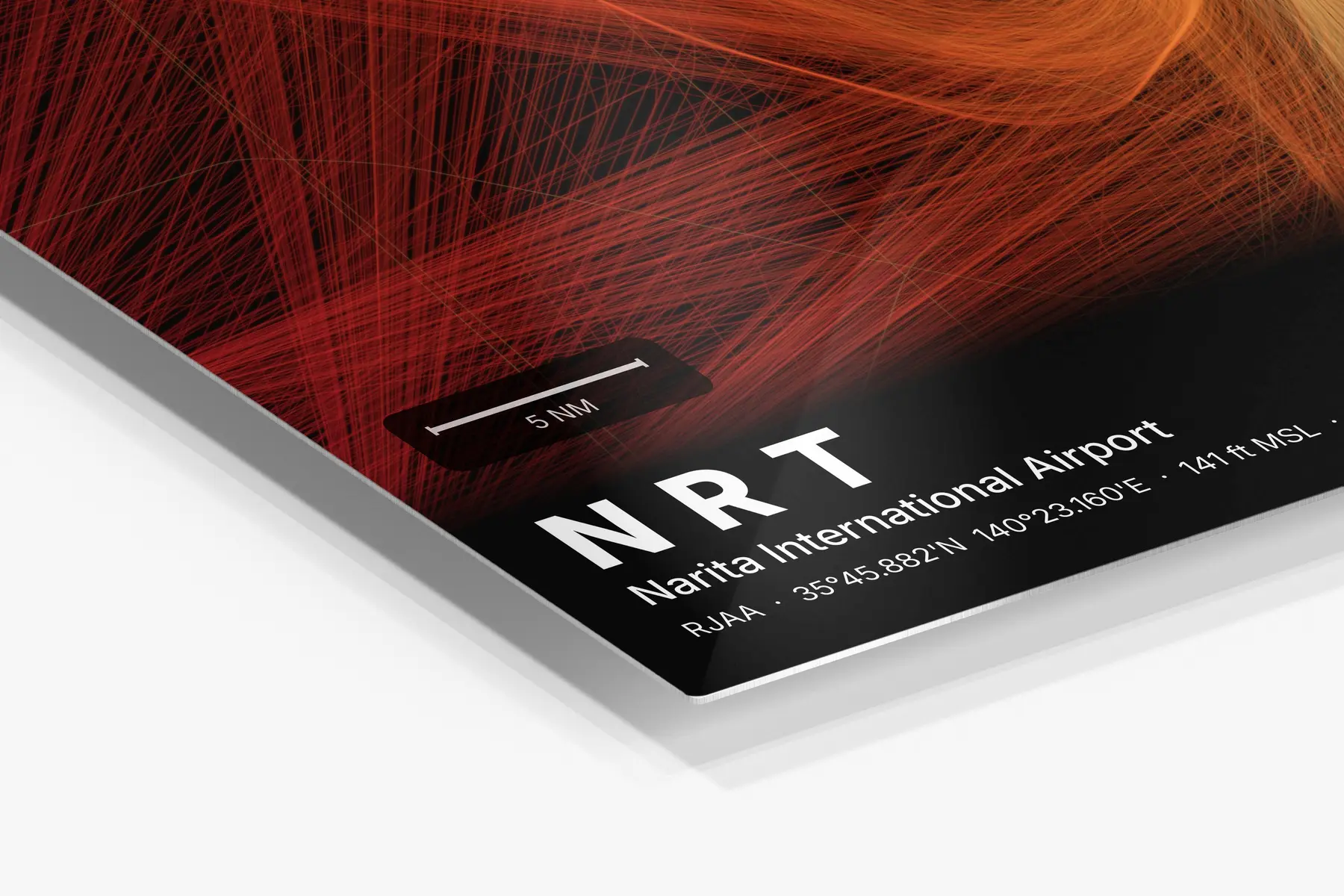
NRT

Narita International Airport

Narita International Airport (NRT) is Japan's primary international gateway, linking Tokyo to long-haul routes across Asia, the Americas, and Europe. Real ADS-B data captures that global reach precisely. Every flight path is colorized by altitude, rendered across your chosen palette.

This print visualizes all 1,936 flights recorded over 3 days — January 1 through January 3, 2026, the heart of Japan's busiest travel period of the year. Printed direct-to-metal on an aluminum panel, it is a piece of aviation wall art that locks in the precise rhythm of NRT at the turn of the new year.

NRT flight path print — Aurora theme in living-room setting [hotspot:46]NRT flight path print — Aurora theme in office setting [hotspot:55]NRT flight path print — Ember theme in living-room setting [hotspot:46]NRT flight path print — Ember theme in office setting [hotspot:55]NRT flight path print — Nebula theme in living-room setting [hotspot:46]NRT flight path print — Nebula theme in office setting [hotspot:55]NRT flight path print — Solstice theme in living-room setting [hotspot:46]NRT flight path print — Solstice theme in office setting [hotspot:55]NRT flight path print — Sky theme in living-room setting [hotspot:46]NRT flight path print — Sky theme in office setting [hotspot:55]NRT flight path print — Coast theme in living-room setting [hotspot:46]NRT flight path print — Coast theme in office setting [hotspot:55]NRT flight path print — Rose theme in living-room setting [hotspot:46]NRT flight path print — Rose theme in office setting [hotspot:55]NRT flight path print — Iris theme in living-room setting [hotspot:46]NRT flight path print — Iris theme in office setting [hotspot:55]

Dye-sublimated on aluminum · Float mount hardware included

$119

Made to order in 2–3 daysMade in the USA
Behind the Print

Statistics from the ADS-B flight data visualized in this print.

1,936

Total Flights

605

Unique Aircraft

163

Peak Hour Flights

This dataset covers three days of ADS-B traffic at Narita International Airport (NRT/RJAA) from January 1 to January 3, 2026, capturing 1,936 total flight operations across 605 unique aircraft. Arrivals numbered 947 and departures 984, with 5 touch-and-go events also recorded. The busiest hour was 15:00 JST, which logged 163 movements, 106 of them arrivals. Average throughput across the day ran 26.9 flights per hour, with active operations spanning from 09:00 to 23:59 local time. Early morning hours between 03:00 and 04:00 saw zero recorded movements, while the 05:00 hour brought 14 arrivals and no departures. Incheon International Airport (ICN) was the top connected airport by total movements, with 90 arrivals and 115 departures for a combined 205 flights. Kagoshima Airport (KOJ) appeared exclusively as a departure destination with 152 outbound flights and zero arrivals. Fukue Airport (FUJ) followed closely with 151 total movements. Hong Kong (HKG) and Taipei Taoyuan (TPE) each recorded 45 arrivals and no departures in this window. Approach traffic was dominated by the WSW direction at 351 counts, followed by SW at 148 and WNW at 135. Departure tracks showed a similar westward concentration, with WSW again leading at 418. Altitude data spans from ground level up to a recorded maximum of 46,925 feet, reached by a US-registered aircraft (N814PR) on an arrival. The average altitude across all tracked points was 19,455 feet. The 4,000 to 5,000 foot band was the most densely sampled at 50,320 data points, consistent with approach and departure transition altitudes. Cruise-level activity concentrated between 33,000 and 40,000 feet. Japanese-registered aircraft made up the largest share of unique aircraft by country at 163, followed by China at 105 and the United States at 65. The dataset totals 992,092 individual ADS-B position points across all flights.

Every print includes a QR code linking to the full flight report.

Full Flight Report
Aluminum print showing flight path visualization
Premium Material

Why Aluminum

Our prints are produced on museum-grade aluminum with a high-gloss finish — the choice of professional galleries worldwide.

Dye-Sublimated

Colors infused directly into the aluminum surface for unmatched vibrancy.

Deep Blacks & Vibrant Color

High-gloss finish delivers exceptional contrast and altitude gradients.

Archival Durability

Scratch-resistant, waterproof, and fade-resistant for decades of display.

Modern Float Mount

Included mounting hardware creates a sleek 3/4" float off the wall.

Gallery-Quality Finish

The same premium process used by museums and professional galleries.

About the Airport

Narita International Airport opened in May 1978, replacing Tokyo International Airport (Haneda) as Japan's main hub for international traffic. Its opening was not without controversy — years of protests by local farmers and activist groups delayed construction and shaped the airport's unusually fortified perimeter. That turbulent start is a defining chapter in Japanese aviation history.

Situated in Chiba Prefecture, roughly 60 kilometers east of central Tokyo, NRT sits at a considerable distance from the city it serves. That geography has long been a point of criticism, with surface transit times running an hour or more by express rail. Despite this, the airport grew into one of Asia's most important international hubs, handling connecting traffic between North America and destinations across Southeast Asia and the Pacific. Two passenger terminals and 3 runways support a route network served by dozens of international carriers, with Japan Airlines and All Nippon Airways anchoring operations.

NRT is particularly significant as a transpacific gateway. Routes connecting Tokyo to Los Angeles, New York, and other major North American cities have operated from here for decades, making the airport a linchpin in global long-haul aviation. The new year holiday period — shōgatsu — is among the busiest stretches on the Japanese calendar, driving a surge in both domestic connections and international departures. In recent years, Haneda has absorbed a growing share of international routes as slot allocations were expanded, putting NRT under pressure to compete. Still, the airport remains a critical node in the Asia-Pacific network, processing tens of millions of passengers annually.