Chicago O'Hare International Airport
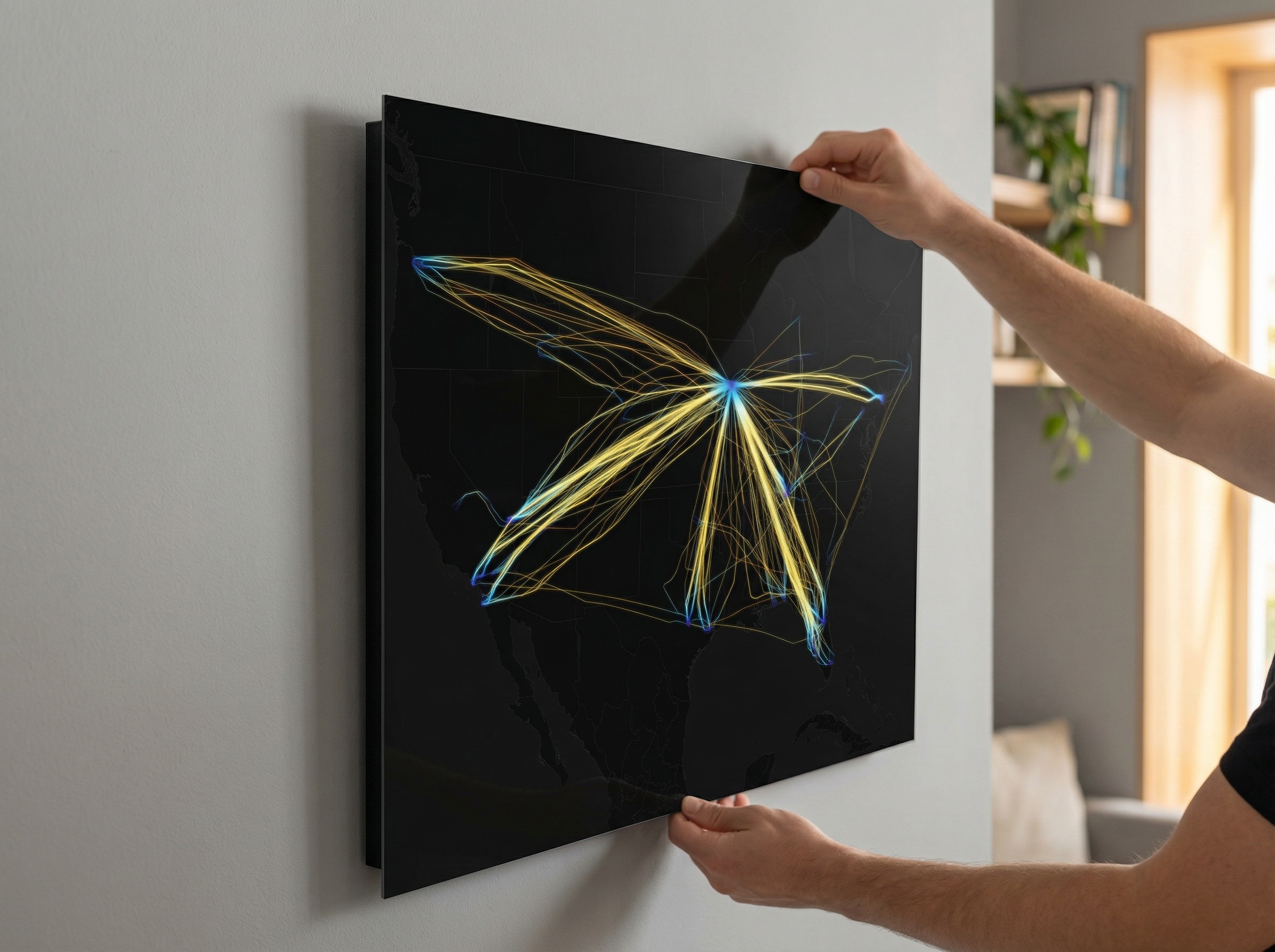
Chicago O'Hare International Airport (ORD) is one of the world's most connected aviation hubs, linking the American Midwest to destinations across every continent. This print maps that reach directly — rendered from real ADS-B flight tracking data. Every flight path is colorized by altitude across your chosen palette.
This print visualizes all 2,226 flights recorded on October 1, 2025 — the 70th anniversary of ORD's opening to commercial aviation. Printed direct-to-metal on an aluminum panel, it is a piece of aviation wall art that fixes a landmark moment in the airport's history into something permanently worth looking at.
![ORD flight path print — Inferno theme · Dark in living-room setting [hotspot:46]](https://cdn.shopify.com/s/files/1/0818/7710/6930/files/living-room_7e61a237-b31c-4ef1-98c5-7d02457d9ca3.webp?v=1779131598&width=3840)
![ORD flight path print — Inferno theme · Dark in office setting [hotspot:55]](https://cdn.shopify.com/s/files/1/0818/7710/6930/files/office_189222f4-575a-482b-9742-299339c9bfd7.webp?v=1779131600&width=3840)
![ORD flight path print — Solana theme · Dark in living-room setting [hotspot:46]](https://cdn.shopify.com/s/files/1/0818/7710/6930/files/living-room_51c8d23a-42fc-4808-952f-5851f70699be.webp?v=1779131603&width=3840)
![ORD flight path print — Solana theme · Dark in office setting [hotspot:55]](https://cdn.shopify.com/s/files/1/0818/7710/6930/files/office_b0d11afb-20cf-49a6-999e-ecc08d780c82.webp?v=1779131604&width=3840)
![ORD flight path print — Citrus theme · Dark in living-room setting [hotspot:46]](https://cdn.shopify.com/s/files/1/0818/7710/6930/files/living-room_82caafc5-7400-4afe-9ce4-e9725d3e92ef.webp?v=1779131608&width=3840)
![ORD flight path print — Citrus theme · Dark in office setting [hotspot:55]](https://cdn.shopify.com/s/files/1/0818/7710/6930/files/office_4cd12550-e618-4f43-8114-e709af4495d2.webp?v=1779131611&width=3840)
![ORD flight path print — Blossom theme · Dark in living-room setting [hotspot:46]](https://cdn.shopify.com/s/files/1/0818/7710/6930/files/living-room_8b3f95c0-7ea1-47cb-8cf1-614b60aadfb9.webp?v=1779131614&width=3840)
![ORD flight path print — Blossom theme · Dark in office setting [hotspot:55]](https://cdn.shopify.com/s/files/1/0818/7710/6930/files/office_38cecae0-b03b-40b1-a473-d9e01f74e9fe.webp?v=1779131616&width=3840)
![ORD flight path print — Prism theme · Dark in living-room setting [hotspot:46]](https://cdn.shopify.com/s/files/1/0818/7710/6930/files/living-room_b7997fe9-a77f-41a4-9ba2-33fcca331729.webp?v=1779131619&width=3840)
![ORD flight path print — Prism theme · Dark in office setting [hotspot:55]](https://cdn.shopify.com/s/files/1/0818/7710/6930/files/office_3eb57d5d-583a-41d7-847b-f5cdfe22a309.webp?v=1779131621&width=3840)
![ORD flight path print — Inferno theme · Light in living-room setting [hotspot:46]](https://cdn.shopify.com/s/files/1/0818/7710/6930/files/living-room_254dd230-171c-40f1-906a-fd00f115e2cd.webp?v=1779131624&width=3840)
![ORD flight path print — Inferno theme · Light in office setting [hotspot:55]](https://cdn.shopify.com/s/files/1/0818/7710/6930/files/office_dec6cf4f-b11e-4b12-83d9-d6fedd7a2138.webp?v=1779131625&width=3840)
![ORD flight path print — Solana theme · Light in living-room setting [hotspot:46]](https://cdn.shopify.com/s/files/1/0818/7710/6930/files/living-room_721adc47-7d0e-4590-bf9e-7dba44ea4b92.webp?v=1779131629&width=3840)
![ORD flight path print — Solana theme · Light in office setting [hotspot:55]](https://cdn.shopify.com/s/files/1/0818/7710/6930/files/office_90708962-2da4-4416-af53-f0d75a0c6699.webp?v=1779131631&width=3840)
![ORD flight path print — Citrus theme · Light in living-room setting [hotspot:46]](https://cdn.shopify.com/s/files/1/0818/7710/6930/files/living-room_5e43e8bf-a227-4101-8620-2d3abcc0f5e5.webp?v=1779131634&width=3840)
![ORD flight path print — Citrus theme · Light in office setting [hotspot:55]](https://cdn.shopify.com/s/files/1/0818/7710/6930/files/office_4328e33f-6e74-4741-b67b-1f461d501db9.webp?v=1779131636&width=3840)
![ORD flight path print — Blossom theme · Light in living-room setting [hotspot:46]](https://cdn.shopify.com/s/files/1/0818/7710/6930/files/living-room_39cee192-e29c-42d1-9d47-fc2fa97aeca6.webp?v=1779131639&width=3840)
![ORD flight path print — Blossom theme · Light in office setting [hotspot:55]](https://cdn.shopify.com/s/files/1/0818/7710/6930/files/office_508f7ff3-3c6a-4bb9-a73e-7c7938660ad0.webp?v=1779131640&width=3840)
![ORD flight path print — Prism theme · Light in living-room setting [hotspot:46]](https://cdn.shopify.com/s/files/1/0818/7710/6930/files/living-room_e778be4d-60ab-4632-a3ee-43c438e48adb.webp?v=1779131644&width=3840)
![ORD flight path print — Prism theme · Light in office setting [hotspot:55]](https://cdn.shopify.com/s/files/1/0818/7710/6930/files/office_ee03cdc9-7f47-4770-b609-d5a0010b5265.webp?v=1779131645&width=3840)


Chicago O'Hare International Airport
Chicago O'Hare International Airport (ORD) is one of the world's most connected aviation hubs, linking the American Midwest to destinations across every continent. This print maps that reach directly — rendered from real ADS-B flight tracking data. Every flight path is colorized by altitude across your chosen palette.
This print visualizes all 2,226 flights recorded on October 1, 2025 — the 70th anniversary of ORD's opening to commercial aviation. Printed direct-to-metal on an aluminum panel, it is a piece of aviation wall art that fixes a landmark moment in the airport's history into something permanently worth looking at.
Dye-sublimated on aluminum · Float mount hardware included
$119
Every ADS-B-tracked flight visualized in this print — captured on a single day.
2,226
Total Flights
858
Unique Aircraft
1,591,938
ADS-B Points
This page captures ADS-B traffic data for Chicago O'Hare International Airport (ORD/KORD) on October 1, 2025, the 70th anniversary of the airport's opening to commercial aviation. Over the course of the single day, 2,226 flights were recorded across 858 unique aircraft, averaging 92.8 flights per hour. The split between arrivals and departures was close but not even: 1,164 arrivals versus 1,062 departures. Traffic ran continuously from 00:00 to 23:59 CDT, though the overnight hours were sparse, with fewer than 15 total movements in each of the first two hours. The 17:00 hour was the busiest of the day at 161 total flights, with 92 arrivals and 69 departures. Several other hours also crossed 150 movements, including 11:00 (156), 15:00 (157), and 18:00 (149). Approach and departure directions were broadly distributed, but east was the most common vector for both arrivals (165) and departures (162), followed by west and SSE. The top route by combined frequency was ORD-LGA, with 30 arrivals and 30 departures. DCA, DFW, DTW, DEN, and MSP each accounted for 31 combined movements. Toronto Pearson (YYZ) was the only non-U.S. airport in the top ten, with 30 total flights. Altitude data spans 1,591,938 ADS-B position points. The most frequently observed altitude band was 1,000-2,000 feet (139,508 points), followed by a secondary concentration between 35,000 and 38,000 feet, where the three busiest high-altitude bands each exceeded 55,000 points. The highest recorded altitude was 46,575 feet, logged by N60CK on a departure to Laconia Municipal Airport (LCI). The longest flight by distance was an arrival from Washington Dulles (IAD) covering 4,076.8 nautical miles over 818.6 minutes. Of the 858 unique aircraft, 774 were registered to the United States, with smaller counts from Canada (10), China (8), Japan (7), and 14 other countries.
Every print includes a QR code linking to the full flight report.
Why Aluminum
Our prints are produced on museum-grade aluminum with a high-gloss finish — the choice of professional galleries worldwide.
Dye-Sublimated
Colors infused directly into the aluminum surface for unmatched vibrancy.
Deep Blacks & Vibrant Color
High-gloss finish delivers exceptional contrast and altitude gradients.
Archival Durability
Scratch-resistant, waterproof, and fade-resistant for decades of display.
Modern Float Mount
Included mounting hardware creates a sleek 3/4" float off the wall.
Gallery-Quality Finish
The same premium process used by museums and professional galleries.
About the Airport
Chicago O'Hare International Airport opened to commercial aviation on October 1, 1955, on the site of a former Douglas Aircraft manufacturing plant on Chicago's northwest side. The airport took its IATA code, ORD, from Orchard Place, the name of the original airfield. It was named in honor of Navy Lieutenant Commander Edward "Butch" O'Hare, a World War II Medal of Honor recipient and Chicago native.
For much of the late 20th century, ORD was the busiest airport in the world by total operations. Today it remains one of the largest aviation hubs in North America, serving as a primary hub for both United Airlines and American Airlines. That dual-hub status makes it a critical interchange point — a place where domestic and international networks converge in ways few airports in the world can match.
The airport sits roughly 17 miles northwest of downtown Chicago. Its runway layout reflects decades of incremental expansion, with 8 runways configured to allow parallel operations and high throughput even in difficult weather. A long-running modernization program, O'Hare 21, has reshaped parts of the terminal infrastructure and added runway capacity. The airport handles a broad mix of traffic — legacy carriers, low-cost operators, regional feeders, and international widebody services to Europe, Asia, and beyond. Its location in the center of the continent means it functions as a true connecting hub, not just a gateway to a single city or region.