Chicago O'Hare International Airport
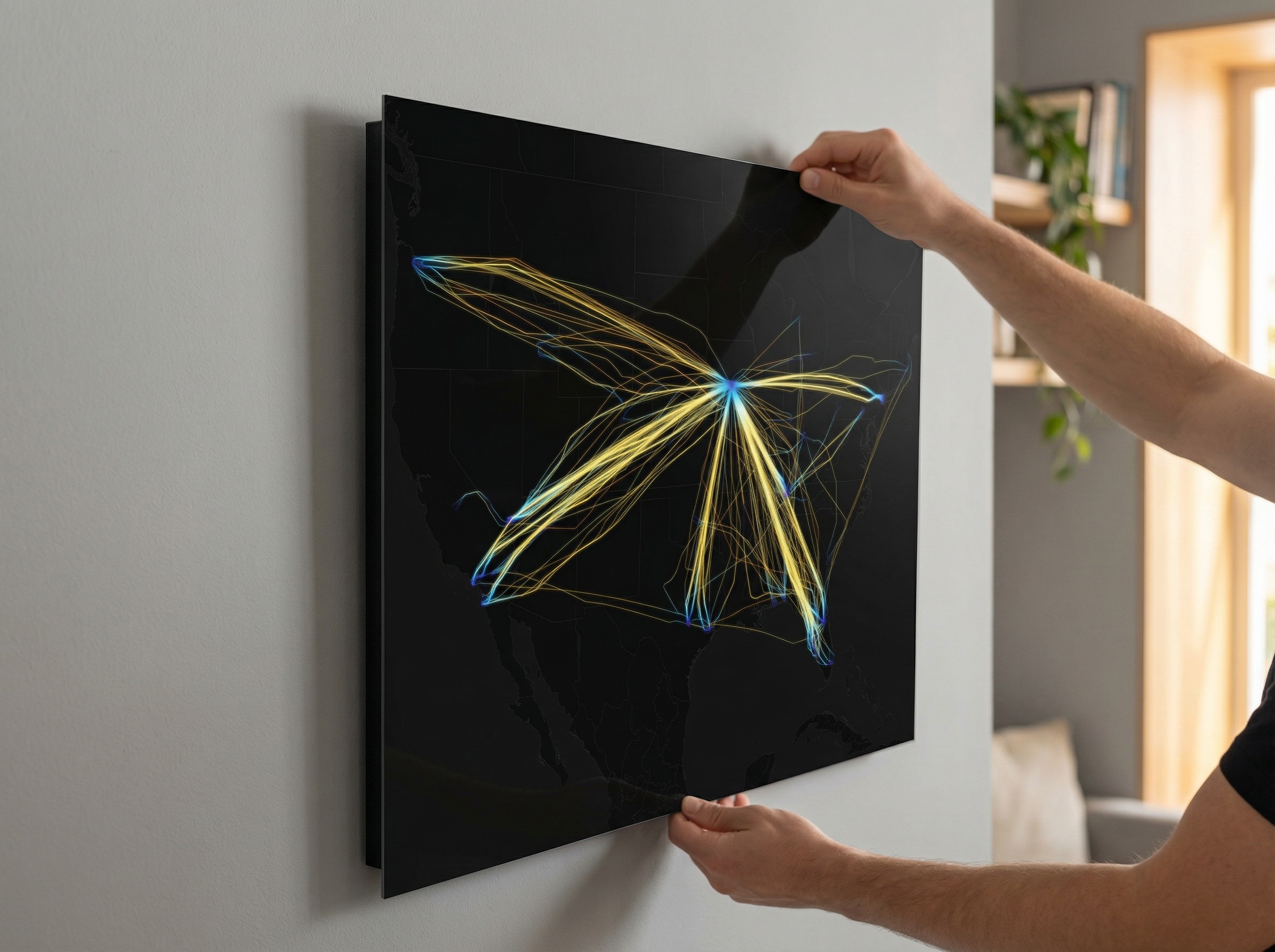
Chicago O'Hare International Airport (ORD) is one of the world's most connected hubs, threading together domestic corridors and transatlantic routes from the heart of the Midwest. This metal print captures that reach — built from real ADS-B flight tracking data. Every path is colorized by altitude, rendered across your chosen palette.
This print visualizes all 2,375 flights recorded on October 1, 2025 — the 70th anniversary of the airport's opening day. Printed direct-to-metal on an aluminum panel, it is a piece of aviation wall art that holds a milestone moment in the history of one of aviation's great crossroads.
![ORD flight path print — Aurora theme in living-room setting [hotspot:46]](https://cdn.shopify.com/s/files/1/0818/7710/6930/files/living-room_63f57be3-fbe2-4a35-b71d-1994d6f848fb.webp?v=1776111939&width=3840)
![ORD flight path print — Aurora theme in office setting [hotspot:55]](https://cdn.shopify.com/s/files/1/0818/7710/6930/files/office_fedd8731-2b0e-4696-a62f-d5fe93c91b1f.webp?v=1776111940&width=3840)
![ORD flight path print — Ember theme in living-room setting [hotspot:46]](https://cdn.shopify.com/s/files/1/0818/7710/6930/files/living-room_363ed14b-666e-4e6d-b2c1-5cb968e9f89d.webp?v=1776111943&width=3840)
![ORD flight path print — Ember theme in office setting [hotspot:55]](https://cdn.shopify.com/s/files/1/0818/7710/6930/files/office_da140b6c-2f1c-47f0-9899-5062939d79f2.webp?v=1776111945&width=3840)
![ORD flight path print — Nebula theme in living-room setting [hotspot:46]](https://cdn.shopify.com/s/files/1/0818/7710/6930/files/living-room_3dab7a22-3f48-4bc0-a63c-326eacf340ac.webp?v=1776111948&width=3840)
![ORD flight path print — Nebula theme in office setting [hotspot:55]](https://cdn.shopify.com/s/files/1/0818/7710/6930/files/office_fab7709a-fda0-4551-a425-4280c81b5de7.webp?v=1776111949&width=3840)
![ORD flight path print — Solstice theme in living-room setting [hotspot:46]](https://cdn.shopify.com/s/files/1/0818/7710/6930/files/living-room_59ffe9e6-c816-4322-95a9-d4b272824954.webp?v=1776111953&width=3840)
![ORD flight path print — Solstice theme in office setting [hotspot:55]](https://cdn.shopify.com/s/files/1/0818/7710/6930/files/office_6dab1b3c-596d-4cfc-b75a-9ab9cf4b61fa.webp?v=1776111954&width=3840)
![ORD flight path print — Sky theme in living-room setting [hotspot:46]](https://cdn.shopify.com/s/files/1/0818/7710/6930/files/living-room_369d6eec-d2b4-47db-9dfd-07b99bfaf505.webp?v=1776111958&width=3840)
![ORD flight path print — Sky theme in office setting [hotspot:55]](https://cdn.shopify.com/s/files/1/0818/7710/6930/files/office_0064af4b-3d9e-411f-a4e4-bad34d199fa2.webp?v=1776111959&width=3840)
![ORD flight path print — Coast theme in living-room setting [hotspot:46]](https://cdn.shopify.com/s/files/1/0818/7710/6930/files/living-room_fc9000c9-a6c3-4936-be9a-ea103dc98016.webp?v=1776111962&width=3840)
![ORD flight path print — Coast theme in office setting [hotspot:55]](https://cdn.shopify.com/s/files/1/0818/7710/6930/files/office_e7c811f3-5de2-4579-b8bd-b80d1596a50a.webp?v=1776111964&width=3840)
![ORD flight path print — Rose theme in living-room setting [hotspot:46]](https://cdn.shopify.com/s/files/1/0818/7710/6930/files/living-room_9cf16081-e713-4506-bbfa-aa0c6a8ef55c.webp?v=1776111967&width=3840)
![ORD flight path print — Rose theme in office setting [hotspot:55]](https://cdn.shopify.com/s/files/1/0818/7710/6930/files/office_936fa402-a84c-449d-b857-2e20e4cf953a.webp?v=1776111969&width=3840)
![ORD flight path print — Iris theme in living-room setting [hotspot:46]](https://cdn.shopify.com/s/files/1/0818/7710/6930/files/living-room_b5c626d8-4910-4cc8-996a-c15b6c0e60cf.webp?v=1776111973&width=3840)
![ORD flight path print — Iris theme in office setting [hotspot:55]](https://cdn.shopify.com/s/files/1/0818/7710/6930/files/office_b605e058-3971-4cb7-9318-1af7333c2565.webp?v=1776111974&width=3840)


Chicago O'Hare International Airport
Chicago O'Hare International Airport (ORD) is one of the world's most connected hubs, threading together domestic corridors and transatlantic routes from the heart of the Midwest. This metal print captures that reach — built from real ADS-B flight tracking data. Every path is colorized by altitude, rendered across your chosen palette.
This print visualizes all 2,375 flights recorded on October 1, 2025 — the 70th anniversary of the airport's opening day. Printed direct-to-metal on an aluminum panel, it is a piece of aviation wall art that holds a milestone moment in the history of one of aviation's great crossroads.
Dye-sublimated on aluminum · Float mount hardware included
$119
Statistics from the ADS-B flight data visualized in this print.
2,375
Total Flights
869
Unique Aircraft
182
Peak Hour Flights
ADS-B radar data captured 2,375 total movements at Chicago O'Hare International Airport (ORD) on October 1, 2025, the airport's 70th anniversary. That figure breaks down to 1,162 arrivals, 1,162 departures, and 51 touch-and-go operations across 869 unique aircraft. Traffic ran continuously from midnight to 23:59 CDT, averaging 99 flights per hour. The peak hour was 17:00 CDT with 182 movements, and the secondary concentrations fell at 11:00 (176) and 15:00 (168). Early morning hours from 00:00 through 05:00 saw minimal activity, with hourly totals ranging from 5 to 22 flights. The busiest route pair was ORD-LGA, with 30 arrivals and 30 departures totaling 60 movements. Minneapolis-Saint Paul (MSP), Denver (DEN), and Reagan National (DCA) each accounted for 33 to 35 total operations. Toronto Pearson (YYZ) was the only non-U.S. airport in the top ten, logging 32 movements. Approach and departure directions were spread widely across the compass, with east and west headings leading both categories. Arrivals from the east numbered 166, and departures toward the east totaled 173. Altitude data derived from 1,638,892 ADS-B position points shows the highest concentration of tracked points between 36,000 and 37,000 feet (66,789 points), with a secondary cluster across the 35,000 to 39,000 foot band. The average recorded altitude was 16,776 feet and the maximum was 46,725 feet, logged by tail number N42MJ on a departure to Knoxville (TYS). The shortest recorded flight was an 8.6 nautical mile arrival from DuPage Airport (DPA) lasting 26.7 minutes. The longest was a 4,074.6 nautical mile arrival spanning 818.6 minutes, flown by N918US originating from Washington Dulles (IAD). Registered aircraft from 22 countries appeared in the data, with U.S.-registered aircraft accounting for 785 of the 869 unique aircraft observed.
Every print includes a QR code linking to the full flight report.
Why Aluminum
Our prints are produced on museum-grade aluminum with a high-gloss finish — the choice of professional galleries worldwide.
Dye-Sublimated
Colors infused directly into the aluminum surface for unmatched vibrancy.
Deep Blacks & Vibrant Color
High-gloss finish delivers exceptional contrast and altitude gradients.
Archival Durability
Scratch-resistant, waterproof, and fade-resistant for decades of display.
Modern Float Mount
Included mounting hardware creates a sleek 3/4" float off the wall.
Gallery-Quality Finish
The same premium process used by museums and professional galleries.
About the Airport
Chicago O'Hare International Airport opened on October 1, 1955, built on the site of a former Douglas Aircraft manufacturing plant in the northwest suburbs of Chicago. The airport was named in honor of Navy Lieutenant Commander Edward "Butch" O'Hare, a World War II Medal of Honor recipient. For much of the late 20th century, it ranked as the busiest airport in the world by total operations.
Geographically, ORD sits at a natural convergence point in the North American air network. Chicago itself is the largest city in the Midwest and a historic rail and logistics hub, and the airport reflects that centrality. United Airlines and American Airlines both maintain major hub operations there, making it one of only a handful of airports in the United States to serve as a fortress hub for 2 competing legacy carriers simultaneously. The airport connects hundreds of domestic markets while also serving as a primary transatlantic gateway for the region.
The airfield is notable for its complex multi-runway configuration. ORD has undergone extensive runway modernization since the early 2000s, including the addition of new parallel runways designed to reduce delays caused by weather and traffic congestion. The terminal layout spans multiple concourses connected by an underground pedestrian tunnel and an automated people mover system. The airport sits roughly 17 miles northwest of downtown Chicago, within Cook County, and serves a metropolitan area of nearly 10 million people. Its sheer scale of operations — thousands of flights daily across carriers ranging from major legacy airlines to regional feeders — makes it a defining node in global aviation.