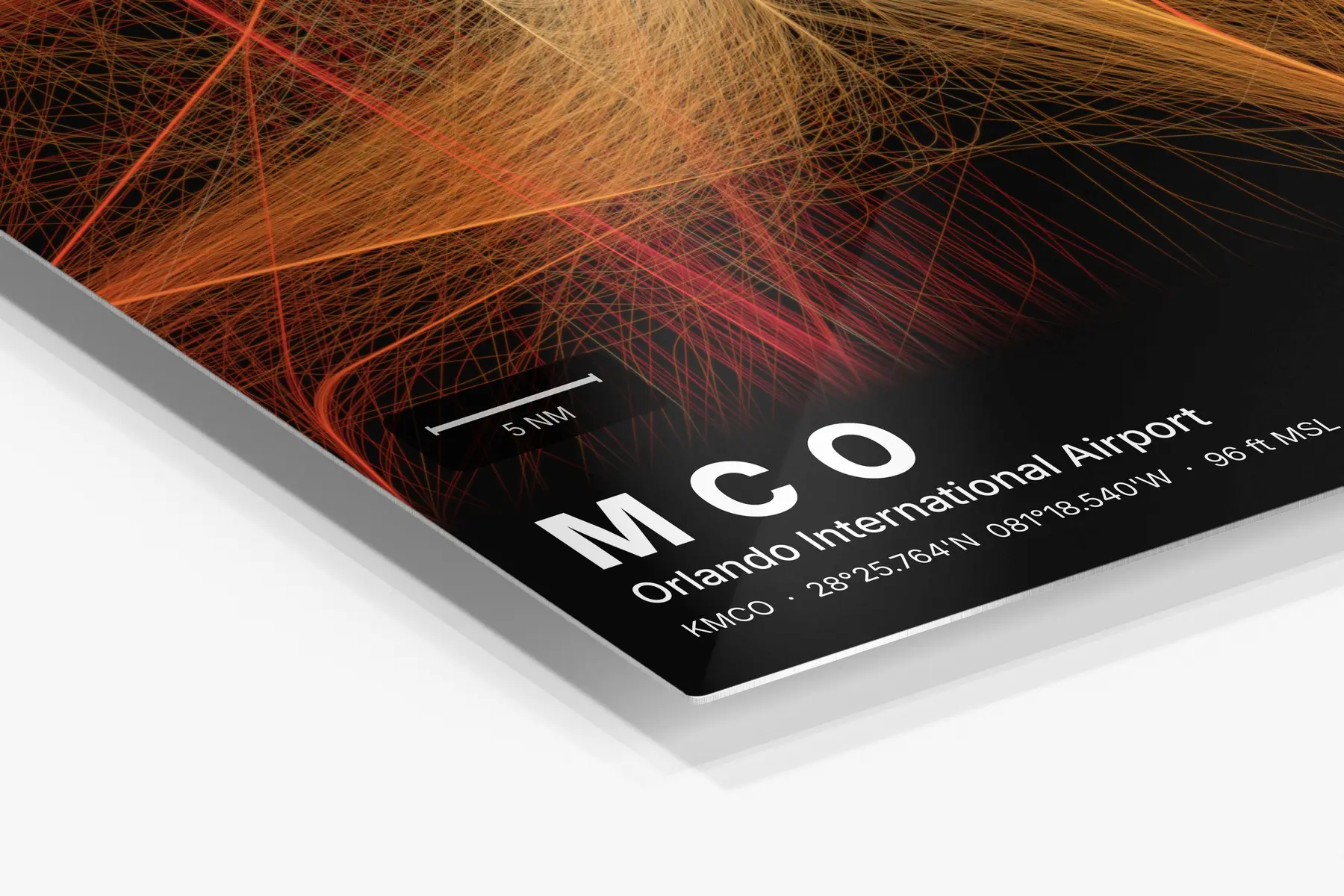
MCO

Orlando International Airport

Orlando International Airport (MCO) is one of the busiest leisure and connecting gateways in the southeastern United States, funneling millions of travelers into Central Florida each year. This metal print captures that relentless flow — rendered from real ADS-B flight tracking data. Every path is colorized by altitude, vivid across whichever palette you choose.

This print visualizes all 1,129 flights recorded on October 6, 2025 — the 38th anniversary of MCO's east terminal complex opening, the move that defined the airport's modern layout. Printed direct-to-metal on an aluminum panel, it is a piece of aviation wall art that locks one landmark day at this airport into something permanent.

MCO flight path print — Aurora theme in living-room setting [hotspot:46]MCO flight path print — Aurora theme in office setting [hotspot:55]MCO flight path print — Ember theme in living-room setting [hotspot:46]MCO flight path print — Ember theme in office setting [hotspot:55]MCO flight path print — Nebula theme in living-room setting [hotspot:46]MCO flight path print — Nebula theme in office setting [hotspot:55]MCO flight path print — Solstice theme in living-room setting [hotspot:46]MCO flight path print — Solstice theme in office setting [hotspot:55]MCO flight path print — Sky theme in living-room setting [hotspot:46]MCO flight path print — Sky theme in office setting [hotspot:55]MCO flight path print — Coast theme in living-room setting [hotspot:46]MCO flight path print — Coast theme in office setting [hotspot:55]MCO flight path print — Rose theme in living-room setting [hotspot:46]MCO flight path print — Rose theme in office setting [hotspot:55]MCO flight path print — Iris theme in living-room setting [hotspot:46]MCO flight path print — Iris theme in office setting [hotspot:55]

Dye-sublimated on aluminum · Float mount hardware included

$119

Made to order in 2–3 daysMade in the USA
Behind the Print

Statistics from the ADS-B flight data visualized in this print.

1,129

Total Flights

544

Unique Aircraft

93

Peak Hour Flights

ADS-B radar data for Orlando International Airport (MCO) captured 1,129 flight operations on October 6, 2025, across 555 arrivals, 563 departures, and 11 touch-and-gos. A total of 544 unique aircraft appeared in the dataset, with 498 registered to the United States. Canadian, British, Brazilian, French, Croatian, Emirati, and Slovenian registrations were also present. Traffic ran continuously from midnight through 23:59 EDT, averaging 47 flights per hour across the day. The busiest hour was 18:00 EDT with 93 total movements, 52 of which were departures. A second concentration appeared at 22:00 with 91 total movements, heavily departure-skewed at 63 outbound against 28 arrivals. Early morning hours from 01:00 through 05:00 saw the lightest traffic, dipping as low as 4 total movements. Approach and departure headings both showed NNE as the dominant direction, accounting for 152 arrivals and 174 departures. Atlanta (ATL) led the top routes with 37 total movements, followed by Charlotte (CLT) at 33 and Philadelphia (PHL) at 30. Altitude data across 861,890 ADS-B position points showed the heaviest concentration between 36,000 and 40,000 feet, with the 36,000-37,000 foot band recording 44,571 points. The average recorded altitude was 20,360 feet and the maximum reached 49,125 feet, logged by tail number N726XJ on a departure toward Waco Regional Airport (ACT). The shortest flight covered 7.9 nautical miles in 3 minutes between MCO and Orlando Executive Airport (ORL). Average leg distance across all flights was 798.9 nautical miles, with a collective distance flown of 901,922 nautical miles.

Every print includes a QR code linking to the full flight report.

Full Flight Report
Aluminum print showing flight path visualization
Premium Material

Why Aluminum

Our prints are produced on museum-grade aluminum with a high-gloss finish — the choice of professional galleries worldwide.

Dye-Sublimated

Colors infused directly into the aluminum surface for unmatched vibrancy.

Deep Blacks & Vibrant Color

High-gloss finish delivers exceptional contrast and altitude gradients.

Archival Durability

Scratch-resistant, waterproof, and fade-resistant for decades of display.

Modern Float Mount

Included mounting hardware creates a sleek 3/4" float off the wall.

Gallery-Quality Finish

The same premium process used by museums and professional galleries.

About the Airport

Orlando International Airport opened in 1981, built on the site of McCoy Air Force Base, which the U.S. Air Force closed in 1975. The transition from military to civilian use was deliberate and phased. A key milestone came in October 1987, when the airport opened its east terminal complex, establishing the distinctive landside-airside layout that still defines the facility today. That hub-and-spoke terminal design — with a central landside terminal connected to remote airside satellites via automated people movers — was considered forward-thinking at the time and has since become central to the airport's operational identity.

Geographically, MCO sits at the intersection of several major interstate corridors in Central Florida, making it accessible from a wide catchment area that extends well beyond Orlando itself. It serves as a primary gateway for leisure travel to the theme parks and attractions that make the region one of the most visited destinations in the world. That demand base gives the airport an unusually high proportion of origin-and-destination traffic compared to pure connecting hubs. Airlines including Southwest, Spirit, and the major network carriers all maintain a substantial presence here.

MCO consistently ranks among the top 10 busiest airports in the United States by passenger volume. Its traffic patterns are shaped as much by vacation cycles and school calendars as by traditional business travel rhythms. The airport has undergone significant expansion in recent years, including the opening of Terminal C in 2022, developed in partnership with the Greater Orlando Aviation Authority to accommodate continued growth. Few airports in the country reflect the character of their surrounding region quite as directly as this one does.