Seen from above, a holding pattern looks like a flat ring, an oval scratched onto the sky over an airport. The picture is lying to you. The ring is the footprint of a building, a column of aircraft stacked over one point in the air, each on its own floor a thousand feet above the one below. The image at the top of this article is a full day over London, every holding loop drawn straight from the tracks the aircraft broadcast, and the four bright rings around Heathrow are not rings at all. They are where four of those columns stood, all day, taking aircraft in at the top and letting them out at the bottom.
The headline first. Of the 996 aircraft we tracked in the terminal airspace over London on February 18, 2026, 295 flew a holding loop. Very nearly one in three. Four columns ring the airport, named for the navigation points they pivot on: Bovingdon to the northwest, Lambourne to the northeast, Ockham to the southwest, Biggin to the southeast. Heathrow is one of the busiest airports in the world and runs near capacity every day, which is exactly why so many of its arrivals end up waiting in the air.
Here is the honest catch in that top-down view. Laying a full day of tracks flat presses the column down into a single ring. The picture cannot show you the height. It shows you two things, and only two: a low cyan core right over the field, where aircraft are down on final, against the warmer loops standing higher and out at the corners; and brightness, how bright each ring burns, which is how heavily that column was worked. The height itself, the stack of floors, is a fact about how holds operate that the flat image flattens away. We have to tell you it is there. So let us start with the floors.
Floors, a thousand feet apart
When more than one aircraft has to wait over the same fix, each gets its own altitude, separated from the next by 1,000 feet, the lowest at the bottom. They fly the same loop on different floors, one above another, like the levels of a building parked over a single point. The ground floor is pulled out and handed to the approach. Everyone above steps down one level. A fresh arrival drops in at the top. The column works down one floor at a time, and the runway empties it from the bottom, so a busy corner of London is a tower of jets grinding slowly toward one strip of concrete. The height of that column is the real measure of how backed up the airport is: a stack two floors deep is a brief wait, a stack eight or ten floors high is a field that cannot land arrivals as fast as they arrive, with the overflow parked above it.
That is what the bright ring at each corner is hiding. Flatten the day and the tower collapses into its footprint. What the render can honestly give you is the gross split, the cyan core over the field where aircraft are low and slow on final, against the warmer holds sitting thousands of feet up and out at the four corners, plus how hard each one was worked. A column run heavily, fed arrival after arrival, burns its ring bright. A quieter one stays dim. But the color does not sweep a gradient up the inside of a hold, and no single ring tells you how many floors were occupied at once. Each loop comes out roughly one warm tone. The depth of the queue, the count of jets stacked over a fix at a given minute, is the one thing the picture keeps from you. You have to be told the building is tall.
Every floor is the same racetrack
Every floor traces the same shape, and it is a defined one. An aircraft crosses the holding fix, flies an outbound leg away from it, makes a 180-degree turn, flies the inbound leg back across the fix, and turns again. Both turns bend the same direction, two half-circles curving the same way, so the legs and the ends close into an oval the aircraft flies again, and again, until it is released. Wind drags the real shape off true, so a hold flown in a stiff breeze comes out lopsided rather than clean. The legs are timed: the inbound run lasts about a minute below 14,000 feet, about a minute and a half higher up, which puts one low circuit at roughly four minutes, a little longer when the wind is fighting it. Many modern holds are defined by a set distance instead of a clock. The oval is the same either way.
The repetition is what makes a column show up at all. An aircraft passing through the airspace on its way somewhere else lays down one faint line and is gone. An aircraft held for half an hour flies that oval seven or eight times, each lap laid almost exactly over the last, and a dozen aircraft cycling through the same floors over the same hour pile their loops one on top of the next. Dim, repeated passes add up into a line you cannot miss. The brighter the ring, the harder the column was worked. It is the one reading the flat picture supports, and a real one.
The shape has outlived the technology under it. Rome Fiumicino still stacks its arrivals over two traditional VOR radio beacons north of the field, Tarquinia and Campagnano, ground stations from the middle of the last century. On January 15, 2026, 24 of the 315 aircraft we tracked there looped over those two beacons. Other fields pivot their holds on satellite-defined points instead, and the oval comes out identical. A hold built on a 1950s radio beacon and a hold built on a GPS waypoint trace the same racetrack. It is one more reason a tracked route so rarely runs in a straight line. The beacon under the hold has changed completely across half a century; the racetrack on top of it has not.

Why the sky needs a waiting room
A runway accepts only so many landings per hour, and arrivals do not arrive at a polite, even pace. They come in clumps. A bank of overnight long-haul flights all reaches the field inside the same dawn hour. A thunderstorm parks across the final approach and shuts it. A runway closes for snow clearing. In each case more aircraft want to land than the airport can take, and the surplus has nowhere to wait but up. On the ground you stand in line. In the air there is no line, so the spare aircraft are sent to a fix and told to fly the loop until a gap opens. The hold is the only waiting room the sky has, and it buys a landing slot with fuel and time, trading the one thing an aircraft carries plenty of for the one thing the airport cannot manufacture on demand. Heathrow runs at capacity daily, so its four columns stand tall as a matter of course.
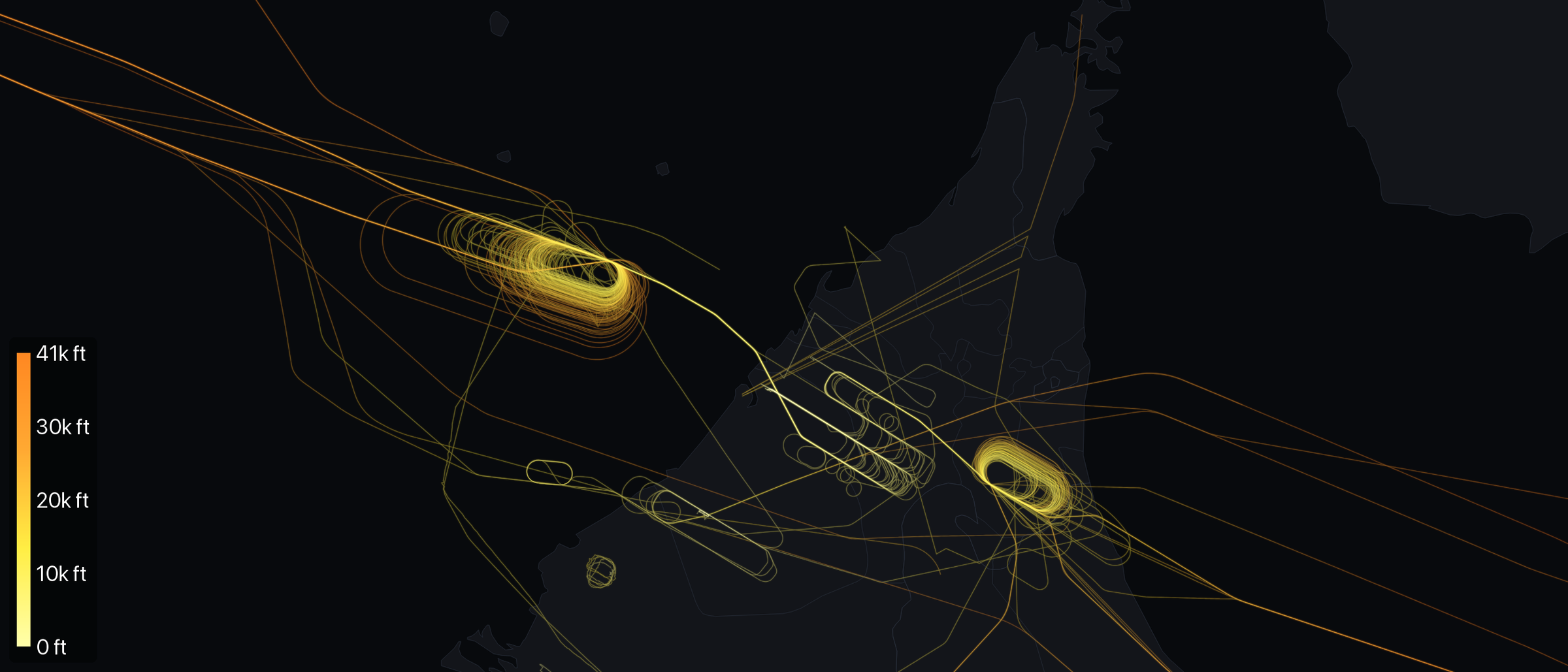
What fills a column is either a bad morning or an ordinary one. Dubai is the bad morning. It sits in a desert and rarely needs to hold at all, until dense winter fog dropped visibility sharply at dawn on February 10, 2026, and the field could no longer take arrivals at its usual rate. 63 of the 472 aircraft we tracked held at Dubai's four RNAV corner-post fixes, the satellite-defined waypoints that anchor its arrivals, and two of those columns were packed deep, their rings worn bright by aircraft circling through the worst of it. More than twenty inbound flights gave up and diverted from the city's airports. The structure was always there in the airspace. It took the fog to fill it.
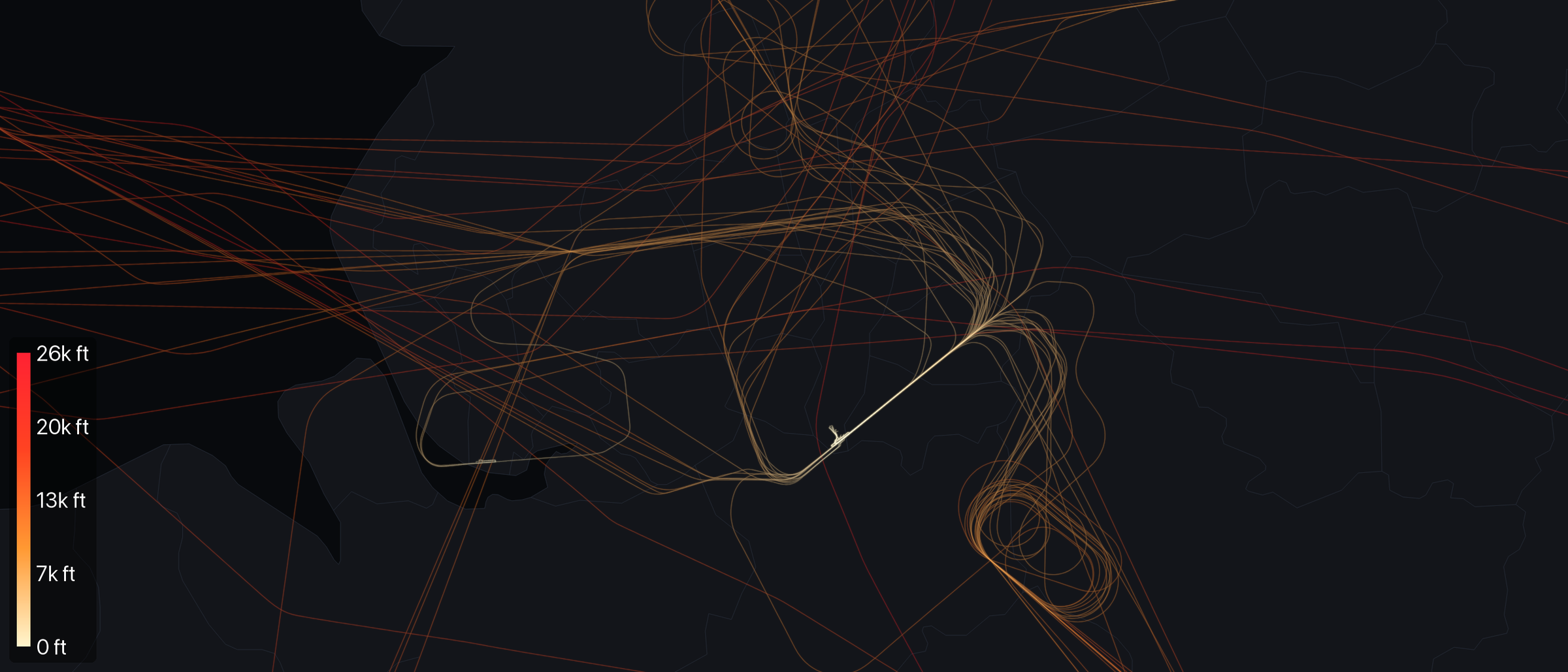
Manchester is the ordinary one. No weather, no emergency, a routine weekday at a major regional hub rather than a global one. On January 15, 2026, 38 of the 325 aircraft we tracked there flew its three published stacks, DAYNE, MIRSI and ROSUN. There is no event to point at. Even an ordinary day's arrival banks can briefly outrun one field, so the columns fill in small amounts all day long. That is the cost of running a busy airport, paid out in four-minute laps.
Fog over a desert, the daily rush at a regional field, an old beacon hold in Italy: the trigger changes from one airport to the next, and so does how deep the column runs. The shape never changes. Only the trigger and the depth do.
The building, drawn by the aircraft
None of these rings is a diagram. Each is the real path of real aircraft on one ordinary day, reconstructed from the position signal every airliner broadcasts about once a second. The brightness is accumulation, hundreds of laps laid over each other, not a line anyone drew. The signal reports where each aircraft was, not the clearance that sent it there, so the thousand-foot floors are the standard stacking procedure read from the outside rather than off a controller's strip. The aircraft really were spaced like that. The reason we can say so is that we watched them do it. And the counts are conservative: a receiver loses parts of some tracks, so 295 over London and 63 over Dubai are a lower bound, the holds we could confirm, not every one flown.
So the building is real, even where the flat picture cannot show its height: permanent infrastructure that stands empty most of the time and fills the moment arrivals back up, a building with no walls and no lights, raised one floor at a time out of jets that will be gone within the hour. The brightest rings are simply the columns that worked hardest. Those recorded shapes, the worn grooves of where aircraft actually went, are the raw material behind the flight-path prints we make at SkyPath.